I
still say STRAIT-JACKET could have been one of the best of the bunch (instead of one of the worst).
It needed clocks ticking (and occasionally chiming), barred owls hooting at opportune moments -- especially right before a murder (and because I just heard one outside my window, which is what made me think to make this post), cricket sounds, lightning and thunder (especially after the Fields' party falls apart), and, of course, way better B&W camera work.
Even the (lack of) door-creakings, and axe-strokes during the killings, are off-paced.
Jeez.
I've decided that the exchange in the dimly-lit (which should have been
more dimly-lit than it was) farm house living room, following the murder of the doctor, that conversation between Carol and Lucy (when Carol finds her mother's knitting on the floor), should be the quiet, karmic peak of the movie -- with a slightly longer soliloquy speech by Crawford, as a grandfather clock's "tick-tock" resonates throughout in the background unnervingly. Leading to Lucy screaming, after already saying it two or three times, "
The doctor's gonnnnnnne!" eight more times. Exactly eight times. As the camera dollies towards her face, visibly over her daughter's shoulder.
And Carol, dressed as Lucy, should pull the axe out of the door frame near the end, and traverse her way through the bathroom towards the mansion's upstairs study. Whacking Mrs. Fields twice with the axe (where Mrs. Fields lays behind the desk, not visible to the camera, having just been electrocuted by a bolt of lightning while on the phone to the police), chocolate syrup spraying the wall just for effect. So you know she's dead and stuff.
So many missed opportunities.
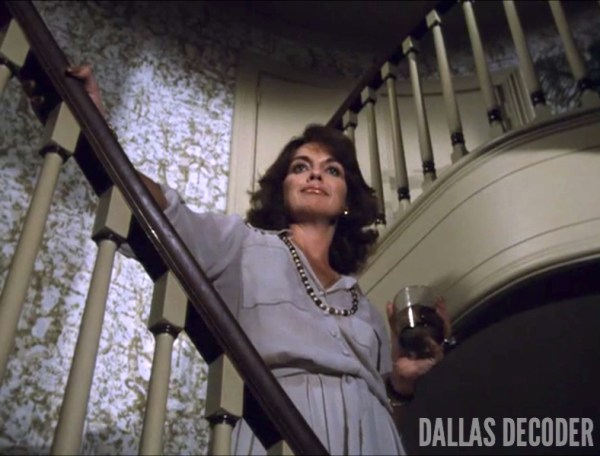
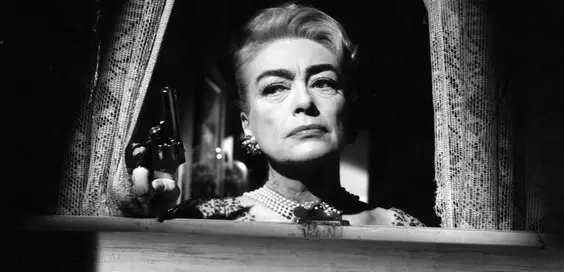
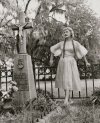
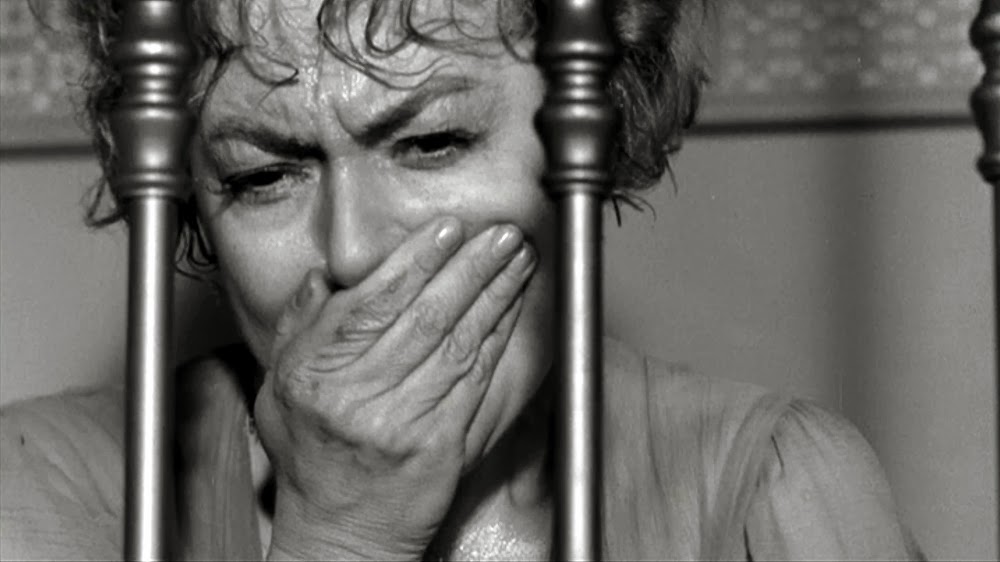
Instead, we got this:
There's the script (far too many scenes end with lines like "You understand, don't you...?"), some of the acting (Diane Baker is a very good actress, but you wouldn't know it from this), the music score reminiscent of an early-'60s sitcom (oh, if only Castle's favorite composer, Von Dexter, hadn't been sidelined by an orthopedic disease which ruined his hands), the choppy editing, and -- worst of all -- the hapless camerawork by Oscar-winning Arthur Arling (best known for THE YEARLING and Doris Day movies with soft-filter close-ups because Day was in her geriatric thirties) because Castle's favorite cinematographer, Joseph Biroc, proved to be unavailable as he was shooting VIVA LAS VEGAS (with Elvis and Ann-Margret). Why all the flat-lighting??
Biroc was a must-have for STRAIT-JACKET if it was going to have any chance to work. He was also Robert Aldrich's favorite DP, and would shoot Joan in HUSH... HUSH, SWEET CHARLOTTE (before she pulled out of the movie) and, two years after STRAIT-JACKET, he'd photograph Joan again for William Castle's I SAW WHAT YOU DID -- a much more polished film, and
far more atmospheric in that strangely cozy way so many of those early-'60s thrillers often were.
Look at I SAW WHAT YOU DID to see what STRAIT-JACKET would have looked like (or how Crawford would have looked had she remained in CHARLOTTE, with her to-period beehive hairdo and giant choker necklaces). Even if nothing else was fixed about STRAIT-JACKET, Joe Biroc -- with his deep shadowing he'd learned during his apprentice years in the silent era, and something he does in the post-production lab work where the register of the blacks & greys cause those shadows to appear conscious and staring back at you -- would've saved the motion picture.
STRAIT-JACKET has a depressing quality about it, but it's that dank, angsty thing that hovered over and encircled the era, the year Kennedy was unceremoniously removed from office by the state (STRAIT-JACKET was filmed in the late-summer of 1963), so I'm fine with that mood to the film.
But it misses the mark so very badly that I consider it a great tragedy of movie history... Again, look what unremembered (and aptly-titled) I SAW WHAT YOU DID to see how STRAIT-JACKET could have felt.
George Kennedy and Leif Erickson are just fine. And the Pepsi vice-president to whom Joan promised the role of the doctor (and apparently had trouble with his lines) is ultimately acceptable, in that his folksy demeanor mostly sells it. And Mr. and Mrs. Fields are properly cast.
Crawford, of course, is terrific.
But amongst William Castle's B-level filmography, STRAIT-JACKET is far-and-away the shittiest entry.
I re-make it, as I've said, in my head every time I see it. Her Edith Head dress in the prologue murder scene is far too dowdy, making Joan appear too flat-chested and dumpy, for the 29-year-old (chuckle!) she's supposed to be. There's the murder itself
with no subjective camera view as she creeps into her house to chop up Heath Barkley and the trollop he picked up in a dive bar at the edge of town... As the face of the little girl fades into the present face of Miss Baker, I want to hear rain on the farm house's tin roof and the shadow of that rain cascading down her face as she explains to her fiancé about her mother's homicidal past.
The dimly lit scene between Lucy and Carol, after the doctor has "disappeared", set in the living room in the farm house, should have been, in a way, the spiritual peak of the movie. But it's not dimly lit
enough. And when Carol screams, "Mother -- tell me!", the camera should have then moved in voyeuristically on Mom, as she yells, "The doctor's gone!!!" eight times with increasing maniacal intensity (as only Crawford could) and young Carol gasps, "Oh, my God!" and runs out the front door to move the doctor's car into the garage (itself, a pointlessly shot and poorly-edited scene).
Other things: the scene in which mother and daughter first meet as adults should be much more effective: Baker, illuminated from the windows, does a slow turn as a tearful Crawford approaches... And I want the hysterical party at the Fields' house late in the film to be considerably more extreme (perhaps with Mrs. Fields actually slapping Joan when grabbed by the shoulders --- and why? It's just drama, baby). And even later, when the murders at the mansion occur, I want a thunderstorm to slip in and, after Crawford runs out of the master bedroom upon un-masking the killer, Baker pulls her axe out of the doorframe and heads through the connecting bathroom towards the study where Mrs. Fields is on the phone to the police; lightning strikes, Mrs. Fields is electrocuted and thrown against the wall, and Baker, glimpsing the phone melting and smoking on the desk (remember, it's melodrama) lands an axe-chop to Mrs. Fields' body now on the floor behind the desk and out of view of the audience, her blood splattering on the wall; then Miss Baker rushes to the stairwell in pursuit of her mother.... I also want the final "hat grabber" scene (as Hitchcock called the Simon Oakland exposition monologue at the end of PSYCHO) in the art studio to offer the badly-needed explanation that Crawford had been chemically altered (i.e., "Bill, last night I found these two drug vials amongst Carol's things. I called the hospital this morning to find out what they were -- one is a mild hallucinogen, the other a sedative. Carol must have given these to me in my food, my drinks -- my coffee, my tea -- so I would see the things she wanted me to see, and react the way she wanted me to react...") And at the final moments of the scene, when she tells her brother, Bill, that "Carol needs me -- she's needed me for a long time, but I was never there to help her.." have Joan walk towards the bust Carol created of her mother's head (and modeled the mask with which to frame her for murder) and add, "And I wasn't there because of a mistake -- a vile, dreadful mistake -- 8000 midnights ago..." (shades of SUNSET BLVD.) "... a mistake that left her paralyzed psychologically -- emotionally imprisoned --- in a kind of strait-jacket..." (as she pulls the cloth over the bust) "..... all of her life." And thus Joan has recited the film's title (which now makes more sense), the morning sunlight begins filtering through the leaves from a tree outside, and she concludes, "Now, maybe, I
can help her." She hugs her brother, and walks out of the art studio, the camera viewing her through the window, over her brother's shoulder, as she strolls into the sunrise in a blustering tornado of autumn leaves. Fade to black. Decapitated 'Columbia' logo. Movie over... The way
any Joan Crawford picture worth its salt should end.
Okay, okay, some of those are just my own little personal aesthetic quirks. But you get the idea.
But how did the William Castle film with the most potential wind up his very worst? Did he care too much -- and did that, perversely, have the effect of ruining it??
I SAW WHAT YOU DID versus STRAIT-JACKET:


-screenshot.jpg)