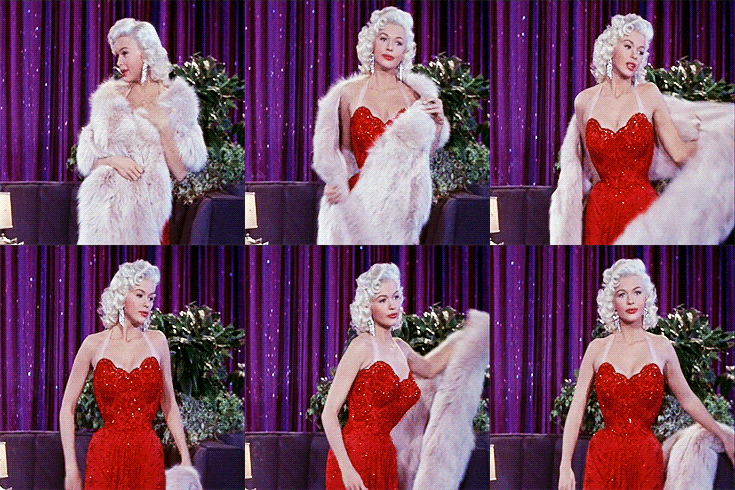
Jayne Mansfield: The Lady in Waiting

ClassyCo

Telly Talk Warrior
LV
5
 
Awards
11
I know I've discussed Miss Mansfield over on the Monroe-esque thread, but I feel she's worthy of her own discussion. So here we go.

I recollect an A&E Biography discussing the Three M's of the fifties movie blonde bombshells: Marilyn Monroe, the undisputed Queen of Glamour, Mamie Van Doren, the Pretender to the Throne, and Jayne Mansfield, the Lady in Waiting.

So, for that reason, I'll subtitle this the Lady in Waiting.

Below is one of my favorite pictures of Jayne. I believe it was taken in 1967, shortly before her death.

JAYNE-MANSFIELD-COLOR-CLOSE-UP-PHOTO-Hollywood.jpg
 

ClassyCo

Telly Talk Warrior
LV
5
 
Awards
11
"Oh, she's got it! Ummm, baby, she's got it!"

jayne2.gif


The rock-n-roll spectacular The Girl Can't Help It, released in late 1956, marked Mansfield's introduction to mainstream movie audiences. She plays a not-so-ditsy blonde bombshell whose boyfriend, gangster Fats Murdock (Edmond O'Brien), has rechristened Jerri Jordan, hoping she will emerge as a great singing star so her can marry her. In his words, "she's a nobody," and he can't marry her until she's somebody. Jerri, however, hasn't the slightest interest in having a show biz career, but instead wants to marry a man she loves (and that man isn't Fats) and settle down into a simple domesticated life. Fats sets her up with talent scout Tom Miller (Monroe's Seven Year Itch costar, Tom Ewell), whose main claim to fame is his discovery of songstress Julie London, represented here in a fictionalized form. Since then, however, Tom's drifted into alcoholism and is haunted by London singing a sexy version of "Cry Me a River" on his apartment's staircase.

As luck would have it, Jerri and Tom start having feelings for one another, and they end up spending more and more time together, with little of it revolving around Tom's job initiating Jerri's career. It isn't long before Fats catches on to their crush, and he warns Tom that he doesn't knock it off, he'll literally knock him off. Tom tries to steer his relationship with Jerri back to a strictly professional one, but Jerri's heartbroken. She's fallen in love with Tom. It's during this time that Tom learns that Jerri, who has previously shown little talent for singing, has an excellent voice and has hidden it so Fats would leave her alone about having a career. Not too much time passes before Jerri and Tom give into their feelings for one another, which comes to a climax in the film's finale. Jerri sings a teary-eyed rendition of "Ev'ry Time (It Happens)". In the epilogue, Tom tells us that all is well; he and Jerri have married, have had a few kids, and Fats has become their "Uncle Fats".

The Girl Can't Help It enjoyed great success when released back in late 1956. Naturally, the rock-n-roll phenomena of the time generated in ticket sales, although this isn't the typical old Hollywood rockin' roller movie. The majority of rock-n-roll movies back then were aimed at teenagers, the genre's biggest fan base, and consisted mostly of B-films shown in drive-in theaters. The Girl Can't Help It turns that entire fad on its head by presenting these rocking musicians in a very glitzy Hollywood fashion. I'm sure it was combination that drew a diverse crowd. Mama Sue could enjoy the romance between the leads, while little Sally and Johnny could rock out to Eddie Cochran and Gene Vincent. At times, however, the inclusion of such musicians seems out of place in the story. When Mansfield reveals herself wearing a dazzling red gown (as shown in the GIF above), she walks to the bathroom as Little Richard belts out "She's Got It" in the background. It isn't that the song is out of context, it's that Little Richard himself is. The scene takes place in an uptown nightclub, cluttered with upper-middle class ladies draped in minks and men in tuxedos. That's not Little Richard's typical arena, and I seriously doubt that people in reality that would attend such a nightclub would stay if Little Richard happened to be playing there.

Visually, this movie couldn't be any more beautiful to me. DeLuxe color definitely kicks it up a notch in the colors here; they're beyond vibrant. Mansfield, herself, is certainly a sight. Her hair, as John Waters once said, must have been touched up every single day. Not for one second do you see any sneak peek of her true brunette strings popping up on screen. Her chemistry with Tom Ewell comes off as natural and it seems the both of them really enjoyed their time making this movie. For fans of old-fashioned rockabilly music, this will be a treat like no other. Personally, the music for me is simply novelty, but it isn't something I necessarily bought or even like the movie for. Some of the songs are good, but to some people the emphasis on rock could be a tad overwhelming. I've heard tell that some think the movie is boxed in because the music so heavily feeds the plot and background instrumentals, while others will feed the other thought that the dominance of rockers only solidifies the film as a testament of a old Hollywood rocker movie done right.

If you haven't gotten around to seeing The Girl Can't Help It yet, I strongly suggest that you do. It is diverse enough that it won't disappoint. Truly a classic on quite a few different levels. Highly Recommended.
 
Last edited:

Snarky Oracle!

Telly Talk Supreme
LV
8
 
Awards
21
whose main claim to fame is his discovery of songstress Julie London, represented here in a fictionalized form. Since then, however, Tom's drifted into alcoholism and is haunted by London singing a sexy version of "Cry Me a River" on his apartment's staircase.
Nobody's better.

Cray%2BMe%2BA%2BRiver.jpg
 

ClassyCo

Telly Talk Warrior
LV
5
 
Awards
11
I'm still in Mansfield mode, and since I was home sick today, I figured I'd binge a couple of her films. I started today with The Wayward Bus, which I purchased off of Zeus a couple of months ago.

The Wayward Bus was Mansfield's first picture following her breakthrough with The Girl Can't Help It. The film was based on John Steinbeck's 1947 novel, and had been tabled as a possible production, with a variety of stars, directors, and writers attached throughout the early 1950s. It finally found its home at 20th Century-Fox, who felt the film version of said novel would be an ideal vehicle for two of its rising stars: Jayne Mansfield and Joan Collins, both of whom had enjoyed success with the studio, and whom executives felt had potential to develop as more serious actresses.

The story primarily takes place on a passenger bus called Sweetheart, the "Wayward Bus" of the title, and chronicles the lives of the variety of passengers traveling to San Juan, Mexico. The bus stop owner, the forty-something Alice (Joan Collins), is married to the slightly younger, Johnny (Rick Jason), whose also the bus driver. Working for them is a cute waitress named Norma and Johnny's something a right arm, a young man originally called Pimples, but who later requests to be called by his given name Ed. Mr. and Mrs. Pritchard are traveling to hopefully reel in their fast-moving daughter, Mildred, who has her eyes on the good-looking Johnny. There's also a smooth talking traveling salesman in the mix, by name of Ernest (Dan Dailey), and a crabby businessman called Brunt.

Miss Mansfield is as beautiful as ever as stripteaser Camille Oakes, a woman seemingly unsatisfied with her choice of career, but who seems somehow conformed to it. Early into the picture, she makes a phone call to inform her next client that she's running a tad behind schedule. He tells her that he liked her pictures showcased in the latest edition of some magazine, the name of which is not mentioned. It so happens that the magazine is on the magazine shelf behind her, and Ernest ends up taking on the bus with them. Ernest is smitten with Camille, but she initially rebuffs his advances. Mr. Pritchard wants to "go into business with Ernest" in California, presumably as a playboy-type charade with call girls, such as Camille, although Ernest doesn't know anything of Camille's past and doesn't share in Mr. Pritchard's ambitions. It isn't long before Ernest's smooth talking wins Camille over and she decides that he is precisely the man she wishes to settle down with.

And it goes on from there. You can watch it for yourself to get filled in on the rest of it.

The Wayward Bus enjoyed reasonable critical and financial success upon its release in 1957. Overall, reviews could certainly be classified as mixed, but not all were negative, while some were generally rewarding. As many reviewers will tell you, and as I am fixing to, Joan Collins is totally miscast here. Her character is to be perceived as a slightly older alcoholic, but she hasn't the age or depth to her acting to make her portrayal close to convincing. (That's a tidbit for you diehard J.C. fans on SC.) As for Jayne, she does rather well with the material given. She couldn't be identified as the sole star of this picture (it's generally an ensemble effort here), but I'd say she was a drawing card for what success this movie got at the box office. Her performance as Camille, a tortured stripper, has been described as subtle, but effective. It certainly isn't typical of the roles she is primarily remembered for playing; the dumb, brightly dressed, dolled up, squealing blonde bombshell that giggles and wiggles. This is something totally different for her, and she does good stretching her legs.

Visually, her appearance here, especially her platinum hair in this crisp B&W picture, brings back to my memories of how Monroe was later photographed in her final picture, The Misfits. Her wardrobe is toned down compared to the likes of The Girl Can't Help It and Will Success Spoil Rock Hunter?, but that doesn't draw back on her attractiveness. She's just as lovely here, perhaps even more so, from a certain perspective, than she was in the other films because she's shown, at least outwardly, with a tad more dignity.

In conclusion, The Wayward Bus is the type of film I generally love; it's got an ensemble cast, intertwining story lines and characters, and a unifying setting to bring them all together. In saying that, this move isn't without its own faults. Apparently, the novel on which it was based had to be "cleaned up" to meet the censors approval, and the reason for its rarity today is because Steinbeck's heirs weren't happy with the film's outcome. I don't have any major complaints about the structure or the execution of said material, but I would say this is a landmark Jayne Mansfield film. Her performance here is quite good, and gives us a slice of just how she could have developed in her acting chops had she been given the chance to do so. She wasn't allowed to, however, and she stuck to the caricature-type that paid her bills for the rest of her carer.

Give The Wayward Bus a gander. You shouldn't be disappointed.

BELOW
While their bus is stuck in a large puddle of water, Ernest (Dan Dailey) tries his hand at wooing Camille (Jayne Mansfield).

48136614742_a50fe5b8d6_b.jpg
 

ClassyCo

Telly Talk Warrior
LV
5
 
Awards
11
Mansfield was recruited in 1960 to star in 20th Century-Fox's comedy called It Happened in Athens. It was first film for the studio in almost two years because she had been overseas doing loan out productions as a result of Fox failure to properly utilize her potential as a star.

It Happened in Athens had all the makings of being a spectacular production. It was going to be shot on location in Greece, filmed in Technicolor and CinemaScope, and was going to give Mansfield her first role in an A-list Hollywood film since 1958. Mansfield was particularly eager, but her dreams were somewhat shattered when she learned that the film was going to be tailored as a vehicle for Fox's promising male star, newcomer Trax Colton.

The story concerns the first Olympic Games in Greece back in 1896. A shepherd, by name of Spiridon Loues (Colton, in a fictionalized but sometimes accurate portrayal of water-carrier Spyridon Louis), decides to enter the 26-mile marathon. Once in Greece, he crosses paths with Christina, a young girl he knows from his home town, whose working as a live-in maid for famous actress Eleni Costa (Mansfield). A love triangle ensues as Eleni sets her eye on Spiridon, although she eventually gives him up because she knows Christina is the woman meant for him.

Mansfield's role is entirely centered around her body, and her flirtation with the men of the cast, particularly Colton. She's quite the eye candy here, but she's slightly "thicker" than she was in her earlier Fox movies. (I mean, she had given birth to two more children by this phase in her life.) She wears a lot of tight, provocative, and showy outfits. There's even a scene where she undresses in her room and reveals herself in a sexy negligee, the outfit she tries to seduce a shirtless Colton in.

Jayne's the only "star" of the movie, and that term is used as a description of her name value and public celebrity, even though in the film itself she is merely a secondary character whose scantily-clad wardrobe was quite daring for the time, I'm sure. Outside of her romance with the men of the cast, her character has little to do with moving forward of the movie's plot. It Happened in Athens was filmed in the fall of 1960, but for what ever reason, Fox decided to sit on the property for two years, not releasing it until June 1962. Ironically, the film received positive notices upon its premiere, particularly from columnist Dorothy Kilgallen, who singled out the movie as a fine comedy, and touted newcomer Trax Colton as having potential of emerging as the newest matinee idol.

It Happened in Athens wasn't a box office success, however. It performed poorly in theaters, and wounded up loosing almost $200,000 for Fox. For the studio, this was the last straw for Mansfield. In their theory, she hadn't proven herself worthy of the publicity they had generated for her because her films were loosing money, and they decided to drop her contract. As for newcomer Trax Colton, this was his first and only leading movie role, after-which he returned to his former career as a used car salesman.

This marked the final attempt by 20th Century-Fox to publicize Mansfield, but they finally gave up on her career and she was no longer viewed as mainstream movie star material. This was also her last top role in a major Hollywood motion picture. Afterwards, she eased into a downward spiral of low-budget oversea flicks, few of which generated any substantial attention in the States. It Happened in Athens isn't necessarily a bad movie, it's just bland.

upload_2019-12-16_16-7-35.png

Trax Colton (born Louis A. Morelli) gave up on his shot at stardom after this movie.
upload_2019-12-16_16-8-29.png
 

ClassyCo

Telly Talk Warrior
LV
5
 
Awards
11
I'm something of an oddity when it comes to reading about old Hollywood stars. It never fails that I become particularly attracted to a certain era in said individual's life, and I spend the majority of my time researching what ever I can about that time period.

Jayne Mansfield is no different. There are specific eras of her life that I feel especially drawn to, and therefore spend significant time with.

There was a time Mansfield placed a strong emphasis on changing her public image. It seems it started around 1962, and it was hit into high gear after Monroe's death that August. Beforehand, Jayne had dyed her hair back to its original brunette for a handful of pictures, such as The Loves of Hercules, but she hadn't made any permanent change from the "dumb blonde" facade she fed to solidify her fame.

Like I said, it seems it all started as the demand for blonde actresses started to decline. As her oldest daughter, Jayne Marie, said: It was 1964 when Jayne wanted to change her image. She decided to move to New York, because that's where more "serious" actresses live. She also changed her look; she started wearing her hair up, she started wearing high-neck dresses, gray and conservative clothes. According to Jayne Marie, her mother became serious about "getting good roles in films," but "they didn't come... that was the problem". Evidently, Mansfield wanted things to change.

But it was too late.

She had solidified herself as the high priestess of the dumb blonde arena. No one had fueled the image as much as Jayne, nor had anyone seemed to relish playing the "character" as much as she. When she tried to remedy her career decline by refreshing her image, it wasn't what the public wanted. They weren't interested in having her any other way. And after a while, she stopped trying. She gave in and became a caricature.

Jayne-Mansfield-brunette-1959.jpg
 

ClassyCo

Telly Talk Warrior
LV
5
 
Awards
11
In 1966, Jayne fell into a relationship with Sam Brody, a lawyer that helped her get her divorce from her third husband, theatre director Matt Cimber. Jayne and Sam began a relationship, one of which included a lot drug, alcohol, and physical abuse. Mansfield's oldest daughter, Jayne Marie, made the front page of the news when she came forth with allegations that Sam had physically assaulted her. The incident put a strain on the mother-daughter relationship, that would unfortunately not recover before Jayne's tragic demise.

Jayne's relationship was a certainly a stormy one from multiple angles. Several close friends and relatives of Jayne recollect many instances where Sam was physically abusive to her. Jayne and Sam went on drinking binges together, which, coupled with Jayne's addiction to prescription pills, worsened her mood swings and strained the relationships she had once held dear. Not helping matters was her movie career being almost non-existent, as film offers had all but dried up. What little film work she obtained consisted of small, exploitation-type parts that capitalized on her physical attributes and notoriety, rather than on any dramatic prowess. These films, a prime example being The Fat Spy, were bombs at the box office, and have since been labeled as some of the worst pictures within American cinema.

Mansfield's destructive relationship with Brody fueled the rapid down-turning of her career in the late 1960s. His abuse left her with bruises, and in many cases, her employers cancelled her engagements, "complaining her legs were too black and blue to wear the miniskirts her act required." Either way, the duo stayed rather faithful to the other (as faithful as a union such as this one can be) until their death in 1967.

BELOW
Jayne Mansfield and Sam Brody in their last known photograph (June 1967)

044248e7f3795be3907bd4857f41a0e1.jpg
 

Seaviewer

Telly Talk Warrior
LV
9
 
Awards
20
The rock-n-roll spectacular The Girl Can't Help It, released in late 1956,
The Beatles were evidently great fans of Jayne Mansfield. In an interview Paul McCartney said they interrupted recording "Birthday" to watch that film on TV, and hers is one of the faces in the collage on the Sgt. Pepper album cover.
 

ClassyCo

Telly Talk Warrior
LV
5
 
Awards
11
The Beatles were evidently great fans of Jayne Mansfield. In an interview Paul McCartney said they interrupted recording "Birthday" to watch that film on TV, and hers is one of the faces in the collage on the Sgt. Pepper album cover.
John Waters and his stable of stars, including Divine and Mink Stole, were fans of Jayne, too. I recall watching an interview of Waters where he said that it was an annual tradition for all of them to sit down and watch The Girl Can't Help It.

It was he that made the remarks about Jayne's touching up her hair every day. In his theory, her hair never once showed any signs of brunette roots, so she must have "touched it up everyday" because no roots were visible, "not even for a second". He also said that, in his world, "Jayne Mansfield is the ultimate movie star".
 

ClassyCo

Telly Talk Warrior
LV
5
 
Awards
11
Jayne filmed The Sheriff of Fractured Jaw with Kenneth More in 1958, a western-spoof shot on location in Spain. It was one of the first westerns to be shot in Spain, and is therefore considered a forerunner to the Spaghetti Westerns that cluttered the genre in the 1960s.

What's interesting, to me at least, about this movie is it's origins. According to reports, this movie was originally proposed by 20th Century-Fox in 1954 and was touted to star Clifton Webb and Marilyn Monroe. For what ever reason, this version never left the drawing board, and it was shelved until Mansfield and Kenneth More picked up the script as a dual vehicle in 1958.

2691520
 

Crimson

Telly Talk Enthusiast
LV
2
 
Awards
9
discussing the Three M's of the fifties movie blonde bombshells: Marilyn Monroe, the undisputed Queen of Glamour, Mamie Van Doren, the Pretender to the Throne, and Jayne Mansfield, the Lady in Waiting

The idea that Van Doren was even vaguely on the same level as Mansfield, let alone Monroe, is kind of absurd. I wonder if there's a single contemporary reference to them as "The Three Ms" -- that seems very much like retroactive wishful thinking on Mamie's part. Jayne was certainly a big deal for a brief period in the mid-50s; she may even have seemed to be a legitimate challenger to Marilyn for a year or two. Van Doren was a real small-time player, whose only brush with respectability came with her supporting role in TEACHER'S PET. where she has like 12 minutes of screen time. Otherwise her career is just crummy B-movies. Joi Lansing and Diana Dors had far more impressive careers, and that's not saying much.
 

Snarky Oracle!

Telly Talk Supreme
LV
8
 
Awards
21
The idea that Van Doren was even vaguely on the same level as Mansfield, let alone Monroe, is kind of absurd. I wonder if there's a single contemporary reference to them as "The Three Ms" -- that seems very much like retroactive wishful thinking on Mamie's part
True, but I do recall Angie Dickinson in an interview maybe 20 years ago saying that when the studio was grooming her for stardom at the end of the '50s and trying to platinum up her brown coif (she never let them lighten her locks beyond a honey-blonde at the time) that she resisted the treatment because "I wasn't going to try and compete with 'those six'..." meaning the three sets of boobies on Marilyn, Mansfield and Mamie.

Today, including Mamie in the trio seems ridiculous. But in 40 years, recalling any Kardashian as having been a "star" might seem that way, too, away from the publicity of the 2000s/2010s.
 

Alexis

Telly Talk Superhero
LV
6
 
Awards
14
It was he that made the remarks about Jayne's touching up her hair every day. In his theory, her hair never once showed any signs of brunette roots, so she must have "touched it up everyday" because no roots were visible, "not even for a second". He also said that, in his world, "Jayne Mansfield is the ultimate movie star".
I mean she was clearly wearing wigs most of the time that's why she has no visible roots showing. There is some serious wiggitry going on in these photos.
 

Crimson

Telly Talk Enthusiast
LV
2
 
Awards
9
I recall reading the opinion that Jayne's career could only have occurred in the mid-50s. Any earlier, she would have been too much; any later, not enough. Only in the high 50s could big boobs and a coy, giddy vulgarity be sufficient for fame.

Whether Jayne could have amounted to more is hard to say. I've only seen THE GIRL CAN'T HELP IT and WILL SUCCESS SPOIL ROCK HUNTER? and neither shows (or requires) any particular talent; she's fun in them rather than funny. She really boxed herself in with that exaggerated image; more of a novelty than a star. If Hollywood hadn't lost interest in Jayne so quickly, I have no idea what other movies she could made. I'm inclined to indulge in mental recasting, but I can't think of a single film role in the late 50s that she would have been suitable for.
 

Snarky Oracle!

Telly Talk Supreme
LV
8
 
Awards
21
I recall reading the opinion that Jayne's career could only have occurred in the mid-50s. Any earlier, she would have been too much; any later, not enough. Only in the high 50s could big boobs and a coy, giddy vulgarity be sufficient for fame.

Whether Jayne could have amounted to more is hard to say. I've only seen THE GIRL CAN'T HELP IT and WILL SUCCESS SPOIL ROCK HUNTER? and neither shows (or requires) any particular talent; she's fun in them rather than funny. She really boxed herself in with that exaggerated image; more of a novelty than a star. If Hollywood hadn't lost interest in Jayne so quickly, I have no idea what other movies she could made. I'm inclined to indulge in mental recasting, but I can't think of a single film role in the late 50s that she would have been suitable for.
TV then? BATGIRL?? (Yvonne Craig sucked, goddess bless her).
 
Top