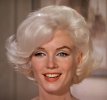
SOME LIKE IT HOT was, on my levels, the biggest critical and box office success of Marilyn's motion picture career. The film originated within the partnership of producer-director Billy Wilder and screenwriter I.A.L. Diamond. The duo had liked the 1935 film called FANFARE OF LOVE, which had been remade in Germany in 1951. The partners took the skeleton of the plot, which consists of two out-of-work male musicians taking jobs in an all-girl band while dressed in drag. They fleshed out the story to make it a farce, and made it where the guys witnessing the St. Valentine's Day Massacre ushers them into having to dress in drag and flee to Florida out of fear of being killed by gangsters.
The two male leads were named Joe and Jerry. A different times, several different well-known performers were considered for those two roles, including Frank Sinatra, Danny Kaye, Jerry Lewis, and Walter Matthau. Apparently, Wilder had made a lunch date with Sinatra, who failed to show up, resulting in Wilder withdrawing him from consideration. Wilder favored newcomer Jack Lemmon for one of the roles, although the studio behind the project, United Artists, felt Lemmon was not yet a big enough star to assure the film's success at the box office. It was then Wilder approached Tony Curtis about accepting the role of Joe, the unofficial leader of the male duo. Curtis readily accepted the part. Wilder and Diamond then turned their attention to casting the part of Sugar, the lead singer of the all-girl jazz band. The duo later remembered that they had written the part with Mitzi Gaynor in mind. Around the same time, Monroe's agent phoned Wilder expressing Monroe's desire to work with the director again. Wilder had directed Monroe in THE SEVEN YEAR ITCH (1955), which had been a big hit. Despite knowing of Monroe's on-set hiccups and tendencies of being unreliable, Wilder agreed to her casting on the assurance that her public popularity would generate big profits at the box office. With Monroe and Curtis both on board, the studio eventually relented to Wilder's requests to have Jack Lemmon play the wisecracking Jerry.
SOME LIKE IT HOT is one of those movies that is infamous for its production history. There were multiple delays during filming, with almost all the blame being directed towards Monroe's behavior. As with many of her other pictures, Monroe was frequently late to the set and often didn't show up at all. When she did show up, she was unfamiliar with the script and had to have her dialogue placed on cue cards around the set. Many people involved with the production spoke of Monroe's reliance on her acting coach Paula Strasberg. Monroe had been training with Lee and Paula Strasberg from the Actors Studio since 1955, and she had learned to rely on Paula's direction to help guide a stronger, more "method" performance. Wilder detested Strasberg, and he resented how Monroe leaned more towards her direction instead of his. Wilder would later comment at how difficult it was to work with Marilyn, but also how magical she appeared on screen. While he agreed other actresses would've been far less trouble, he also stated that nobody could've played Sugar better than Marilyn.
When it was released on March 29, 1959, SOME LIKE IT HOT was a critical and box office smash. Funnily the film's first preview bombed with the audience. As it is told, the audience in attendance had came to see SUDDENLY, LAST SUMMER (1959), and they were put off by a comedy about men running around in drag. The Hays Code had strong objections to Curtis and Lemmon in drag, feeling that such content promoted homosexuality and cross-dressing. Even so, SOME LIKE IT HOT was permitted for a worldwide release, therefore serving as one of the final nails in the Hays Code coffin. The film has went on to have a strong popular culture following, and it was proclaimed the best comedy of all time by the American Film Institute.
Any SOME LIKE IT HOT fans?
SOME LIKE IT HOT was Marilyn Monroe's last hit of her career. It grossed somewhere around $12 million in American theaters in 1959. On the flipside, her final two films -- LET'S MAKE LOVE (1960) and THE MISFITS (1961) -- suffered mixed reviews and indifferent success with audiences. I've often theorized had she been able to complete SOMETHING'S GOT TO GIVE, she would've reversed her fortunes at the box office and had another hit. The movie had all the ingredients for success, but they just "couldn't keep it going" as actress Cyd Charisse said.