The Incomparable Mae West

Snarky Oracle!

Telly Talk Supreme
LV
8
 
Awards
21
It might be fairly common knowledge, especially to avid film buffs, that Mae West was one of the many actresses considered for Scarlett O'Hara in David O. Selznick's heralded screen adaption of GONE WITH THE WIND in the late thirties. The very thought of Mae as Scarlett seems quite laughable in all honesty, and apparently Selznick and his advisors knew she was not the right choice for the part. It seems as if her name was tossed around simply for publicity.

If you do some more digging, however, it seems that Mae was genuinely considered as a serious candidate for Belle Watling, the owner of a brothel in downtown Atlanta. West appears to have never been interested in that part whatsoever, feeling Belle was way too small a role for a star of her stature. I view Mae's offer to play Belle in a few different lights. For one, I can understand how she felt the role was too small, owing to her popularity, and it might have read as a "step down" from her high-horse. On the other hand, however, had Mae played Belle, it might have reignited her career that was in a continuous downward spiral. It may have given her a stronger leg to stand on in finding more serious film work if she had wanted any.

What's your thoughts?


Well, if she thought doing a TV sitcom was a step down, I guess playing Rhett Butler's favorite whore did, too.

No comment about that horse, of course, of course...

9e0077856fe23bddb79fe76a322b1aca.png
 

ClassyCo

Telly Talk Warrior
LV
5
 
Awards
11
Well, if she thought doing a TV sitcom was a step down, I guess playing Rhett Butler's favorite whore did, too.

No comment about that horse, of course, of course...

9e0077856fe23bddb79fe76a322b1aca.png
Apparently. She was still quite popular, name-wise, in the late thirties, and was probably already in talks to do MY LITTLE CHICKADEE with W.C. Fields when the Belle Watling offer was tabled.

And I continue to find it funny how Mae thought Liz and Dick doing HERE'S LUCY was a way cheapening their name, while her doing MISTER ED was viewed as a cutesy career move.

But then again we are discussing Mae West.
 

Snarky Oracle!

Telly Talk Supreme
LV
8
 
Awards
21
In my alternative DYNASTIER world, she was the disreputable matriarch of the ancient De Vulva dynasty of Denver which oversaw a vast brothel empire which stretched across Colorado --- employing the likes of Cora Van Husen, if that explains anything...

1656535178428.png
 
Last edited by a moderator:

Crimson

Telly Talk Enthusiast
LV
2
 
Awards
9
I find the tidbits about Mae possibly being cast as Belle Watling or Norma Desmond to be odd. I've read them often enough from reputable sources that I don't dispute the stories, I just find it weird that Selznick and Wilder would consider her. There's nothing in her filmography to indicate she had acting ability. She had created a comic persona and embodied it, but "acting" -- in the conventional sense of the word -- was simply not a skill she demonstrated. (Mind you, I'm not saying she couldn't act but since she never did, who could say?) It's weird thinking of either GWTW or SUNSET BOULEVARD being overshadowed by a comic.

And, as much as I like him, I think WC Fields was distracting in DAVID COPPERFIELD and I'm glad he wasn't cast as the Wizard.
 

ClassyCo

Telly Talk Warrior
LV
5
 
Awards
11
I've been in a Westian mood the past few days. I've watched the "Mae West and the Men Who Knew Her" documentary that's online I know three or four different times. I've watched the Intimate Portrait one as well, but I don't like it quite as well. It seems to skid over too much for me. I like documentaries that are slam-packed with information.

Mae left Paramount after six years in 1938. Her final movie for the studio, EVERY DAY'S A HOLIDAY (1937), had underperformed in theaters. Independent theater owner Harry Brandt took to labeling her (along with a variety of other well-known stars) as "box office poison" because of her apparent declining popularity. The truth of the matter was that all of Mae's movies outside of EVERY DAY'S A HOLIDAY had turned a profit for Paramount and she was largely credited for saving the studio from falling into bankruptcy during the Depression.

Mae herself scoffed at the notion of being labeled "box office poison":​
"Why, the industry calls me the mortgage lifter," she allegedly quipped while breakfasting in bed. "Whenever business is down they just rerun one of my old pictures. The only movie to make real money was SNOW WHITE and that movie would've made twice as much had I played Snow White."​
West always had a large ego, although one cannot really deny that she knew her worth. The fact was her popularity with audiences was slipping by 1938, and Paramount quietly edged her out as a result. A lot of the blame generally goes to the Hays Code "fastening down" on West and watering down her famous tongue-in-cheek innuendos.

Mae finally got the opportunity to resurrect her film career when Universal Pictures approached her about making a picture with W.C. Fields in 1939. The studio was anxious to duplicate the success of DESTRY RIDES AGAIN, the Western comedy that starred James Stewart and Marlene Dietrich. The film was a runaway success and essentially served as a representation of Dietrich's return to box office glory. While Mae was apparently enthusiastic about returning to movies, she hadn't wanted to co-star W.C. Fields. As Robert Osbourne of TCM later said: Mae preferred starring opposite more handsome, serious leading men like Cary Grant and Warren William. She did not necessarily think of herself as a comedy creation and therefore wasn't pleased about doing a satire where she'd basically be the brunt of Fields' on-screen jokes.

Nonetheless Mae agreed to Universal's requests for her to star in MY LITTLE CHICKADEE, with Mae naturally writing her own material. West had a clause placed in her contract that stated if Fields were to ever show up on the set drunk, he would be quickly removed. "He was fine for about three weeks," Mae later remembered, before Fields showed up on the set drunk. After taking one look at him, Mae ordered him off the set. There was never another issue with his alcoholism. Mae also stated that Fields requested to write his own scene at the bar, and because he did so, he demanded an on-screen credit as joint screenwriter.

MY LITTLE CHICKADEE was a big hit when it opened in 1940. Most websites state that it was the second-most-popular movie at the box office behind GONE WITH THE WIND. To modern-day audiences, the pairing of West and Fields is iconic. The film is a standout of both their careers.​

1629221858178.png

1629222992217.png
 

Crimson

Telly Talk Enthusiast
LV
2
 
Awards
9
MY LITTLE CHICKADEE was a big hit when it opened in 1940.

Although I am not a big fan of most of Mae's films, MY LITTLE CHICKADEE ranks high among my favorite classic films. I watch it almost annually, often paired with DESTRY RIDES AGAIN as a double feature. Mae may spin in her grave, but that is almost entirely because of Fields.

Fields' solo routines in the film are riotously funny; Mae's solo scenes are tepidly amusing. (In fairness, her bawdy humor had been entirely crippled by the Hayes Office by that point.) What's surprising is how well Fields and West work together; even though most of their shared scenes have Mae is basically Fields' straightman, they are hilarious together.

I suspect Mae knew she had been completely upstaged, based on the seething resentment and scorn she directed to Bill and the film for the rest of her life.
 

ClassyCo

Telly Talk Warrior
LV
5
 
Awards
11
Although I am not a big fan of most of Mae's films, MY LITTLE CHICKADEE ranks high among my favorite classic films. I watch it almost annually, often paired with DESTRY RIDES AGAIN as a double feature. Mae may spin in her grave, but that is almost entirely because of Fields.

Fields' solo routines in the film are riotously funny; Mae's solo scenes are tepidly amusing. (In fairness, her bawdy humor had been entirely crippled by the Hayes Office by that point.) What's surprising is how well Fields and West work together; even though most of their shared scenes have Mae is basically Fields' straightman, they are hilarious together.

I suspect Mae knew she had been completely upstaged, based on the seething resentment and scorn she directed to Bill and the film for the rest of her life.
I've never seen DESTRY RIDES AGAIN, but I've often wanted to. I'm a casual fan of Dietrich's films, and this one looks like one of the more interesting ones from her earlier career.

I have seen MY LITTLE CHICKADEE, and I'd agree that West and Fields do work well together. I might need to dive into buying DESTRY so I can saddle up for a double feature myself.

1629312322179.png
1629312347394.png
 

ClassyCo

Telly Talk Warrior
LV
5
 
Awards
11
I bought this nine-movie DVD set from Amazon probably three years ago. Before that I had this five-movie set of Mae's films that I've since given to my sister-in-law. This set includes all of Mae's "glory days" movies from NIGHT AFTER NIGHT right up until MY LITTLE CHICKADEE. I personally wish they would've included THE HEAT'S ON, but I won't loose any sleep over it.

I know some of the reviews out there complain about the quality of the movies in the set. I've never been terribly ticky about the quality of the movies/TV shows I watch (this coming from a guy who watch some awful quality episodes of KNOTS LANDING for its third season). When I've watched the movies from this collection on my big screen TVs they've looked good enough. I mean, c'mon, these movies are over 80 years old. I don't except them to look brand new. And if the quality were to bother me on the bigger screens, I'd just toss them in my laptop and watch them there. Problem solved.

Nevertheless, I'd say this is a good little bundle of Mae's best movies. It's reasonably priced online now too. If anyone were eager to explore Mae's movies, look no further than this set.​

1629312379910.png1629312386482.png
 

ClassyCo

Telly Talk Warrior
LV
5
 
Awards
11
Speaking of THE HEAT'S ON:

Mae hadn't the slightest interest in doing this movie. She hadn't been on the screen since MY LITTLE CHICKADEE in 1940, but here she was at 49 years old in 1943 being approached to headline what is basically a second-rate B-movie for Columbia Pictures. After declining the script on several different occasions, Mae finally agreed when Gregory Ratoff asked her to do the film as a personal favor. That's the only reason she agreed to do it. Although some of the story was tailored to fit West, she was not allowed to rewrite any of her dialogue as was the case for her earlier films.

THE HEAT'S ON ended up failing at the box office. It isn't surprising considering the poor quality of the picture itself. Most people blame the film's failure on the fact that West didn't have her hand in writing the story or her dialogue.

I've seen THE HEAT'S ON on TCM once, and I found it mildly amusing. It certainly isn't West's best film, but it is far from her worst (see MYRA BRECKINRIDGE and SEXTETTE as examples of bottom-of-the-barrel catastrophes). Despite that, I'd say Mae looked very good in the film itself. She seemed to have trimmed down and she looked a little younger than she did in MY LITTLE CHICKADEE from three years prior.​

1629312820882.png1629312828612.png1629312854119.png
 

ClassyCo

Telly Talk Warrior
LV
5
 
Awards
11
I find the tidbits about Mae possibly being cast as Belle Watling or Norma Desmond to be odd. I've read them often enough from reputable sources that I don't dispute the stories, I just find it weird that Selznick and Wilder would consider her. There's nothing in her filmography to indicate she had acting ability. She had created a comic persona and embodied it, but "acting" -- in the conventional sense of the word -- was simply not a skill she demonstrated. (Mind you, I'm not saying she couldn't act but since she never did, who could say?) It's weird thinking of either GWTW or SUNSET BOULEVARD being overshadowed by a comic.

And, as much as I like him, I think WC Fields was distracting in DAVID COPPERFIELD and I'm glad he wasn't cast as the Wizard.
You have a strong point. I cannot say I haven't doubted the legitimacy of Mae's being considered for Belle Watling and Norma Desmond. I've questioned whether or not David O. Selznick or Billy Wilder would've seriously wanted her.

There was no indication given from any of Mae's films proving she could act. All of her films were her playing the same variation of Diamond Lil. Different names, different co-stars (except for the two times she had Cary Grant), but she was always the same ole Mae West. Nothing new was ever added mix.​
 

Crimson

Telly Talk Enthusiast
LV
2
 
Awards
9
but I've often wanted to. I'm a casual fan of Dietrich's films, and this one looks like one of the more interesting ones from her earlier career.

I'm partial Dietrich of this era; just as Crawford hit her zone in the late 40s, Dietrich was in hers in the early 40s. Dietrich of the 30s is kind of a remote goddess , but in the early 40s, beginning with DESTRY, she switched to good natured floosies.

SEVEN SINNERS with John Wayne is one of my favorite movies, even more so than DESTRY RIDES AGAIN.

seven_sinners_GIF.gif
 

ClassyCo

Telly Talk Warrior
LV
5
 
Awards
11
I'm partial Dietrich of this era; just as Crawford hit her zone in the late 40s, Dietrich was in hers in the early 40s. Dietrich of the 30s is kind of a remote goddess , but in the early 40s, beginning with DESTRY, she switched to good natured floosies.

SEVEN SINNERS with John Wayne is one of my favorite movies, even more so than DESTRY RIDES AGAIN.

seven_sinners_GIF.gif
I think my indifference comes from my unfamiliarity with Dietrich's screen work. I've seen her movies, but it's been years. So my opinions aren't the freshest.​
 

ClassyCo

Telly Talk Warrior
LV
5
 
Awards
11
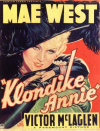
Most friends and biographers agree that Mae found KLONDIKE ANNIE to be her greatest on-screen achievement. The film had originated as a play Mae had written in 1921 called FRISCO KATE, but the property when unproduced on the screen for close to 15 years.

In the film Mae plays a kept woman who murders her keeper. While traveling overseas by ship, she swaps identities with a deceased missionary to avoid arrest. She then embarks on the mission to keep the missionary's goals afloat, although she ultimately decides to turn herself into the police in the end.

KLONDIKE ANNIE ran into serious issues with the Hays Office. It's treatment of religion and hypocrisy were strictly prohibited by the Production Code, and many edits were required before a seal of approval from the office was granted. There was an entire sequence where The Frisco Doll (Mae's character as a "kept woman") dresses the dead body of Sister Annie (the missionary she meets on the ship) up as a prostitute. Such an act was deemed unseemly and it was originally edited out of the final theatrical print of the film. Another scene cut was the one where The Frisco Doll is seen murdering her keeper.

William Randolph Hearst, a powerful newspaper owner, boycotted the film. Hearst had never been a fan of West, vowing to never print her name in his newspapers. Hearst was allegedly annoyed with West over her unflattering remarks made towards his mistress, comedy actress Marion Davies. Hearst's complaints about KLONDIKE ANNIE were that Mae's sexy image was misplaced in a religious setting. West was said to have replied: "I may have invited censorship into Hollywood, but I also saved the industry and Paramount."

KLONDIKE ANNIE generated substantial controversy, even after eight minutes of the film were cut. The state of Georgia went so far to ban the film altogether. Critical reviews overall were mixed and box office sales were lukewarm. Graham Greene, a critic for THE SPECTATOR, gave the film a rather favorable review, calling it Mae's best movie since her star-making vehicle SHE DONE HIM WRONG three years earlier.

Anyone seen this film?​

1629398542475.png1629398581108.png

Apparently the edits required to get KLONDIKE ANNIE released saddened Mae. As one close friend later recalled, "Mae never again tried to do serious acting in her movies. She just stayed Mae West."​
 
Last edited:

ClassyCo

Telly Talk Warrior
LV
5
 
Awards
11
I've been off work the past two days because I need a breather from our being short-staffed. I decided to devote a part of the second day off to watching some Mae West movies I hadn't seen before, or I hadn't watched in a long time. The selections were fairly random... I just popped in the discs from the nine-movie DVD collection I have and clicked a movie I wanted to (re)-visit.

The three I watched were GOIN' TO TOWN (1935), KLONDIKE ANNIE (1936), and EVERY DAY'S A HOLIDAY (1937), all three Post-Code releases that appeared during the time West's popularity was waning.

Let's talk about the movies for a minute:

GOIN' TO TOWN was Mae's fifth motion picture and her first film made after the strict enforcement of the Production Code. It was released in 1935 to lukewarm reviews and financial success.

The film starts out as something of a Western with Mae playing saloon girl Cleo Borden. Naturally, she is the desire of every eligible suitor in sight, although one man in particular, named Buck Gonzalez (Fred Kohler), tries to claim her as his and his alone. Cleo doesn't take to this well, but she eventually agrees to marry Buck once he assures her she was have equal authority over his land and wealth. Before the two could wed, Buck is killed, which renders Cleo the sole inheritor of his land and fortune. Cleo immediately decides to "take stock" of her assets on Buck's farm, and decides to take Edward Carrington (Paul Cavanagh), an Englishman who worked for Buck, as her beau. Edward hasn't any personal interest in Cleo because of her "new money" social status and because of her roots as a saloon girl.

The bulk of the movie is Cleo wiggling her way into high society by any means possible... and all so she can reel in Carrington. She pays nice-looking young men to be her escorts and she follows Carrington to South America to show her wealth by betting on horses. In the end, all turns out well as Cleo finally stabilizes herself in high society and she gets the man of her dreams.

GOIN' TO TOWN isn't the best Mae West movie I've seen, but it's not the worst, either. It's a run-of-the-mill formula movie, which serves West's "naughty" persona quite well. One thing I liked about it was it was quite short (around 75 minutes in length), and therefore got right to the point without a lot of filler.

The movie ends with Mae singing the song "Now I'm a Lady" which concludes with her singing her famous catchphrase "Come up and see me sometime".

1629983723682.png

KLONDIKE ANNIE was released in 1936, and as we've discussed in another comment, was riddled with controversy. It stars Mae was Rose Carlton, nicknamed the Frisco Doll, a "kept woman" living in China with her master (played by the White Harold Huber). She decides to kill her master instead and fleas China on a small ship. On the ship, she becomes to object of desire for the ship captain named Bull (Victor McLaglen), and she befriends Annie (Helen Jerome Eddy), a save-a-soul sister traveling to the mission field. When Annie dies, Rose takes her identity to stay clear of the police looking to arrest her on a murder charge. She carries out Annie's wishes of raising money for missions and eventually turns herself in by pleading self-defense.

KLONDIKE ANNIE is a showcase for Mae West and a good pallet for her witty and suggestive storytelling. The film gives her opportunity to do a few songs and play some interests. It's a little more serious in tone than typical Westian fare, which is perhaps why the censors ripped it in two and pleaded to have the movie removed from circulation.

Many (apparently including Mae) considered KLONDIKE ANNIE as Mae's on-screen masterpiece. I'd say it's definitely her most demanding and complex vehicle. Even with some eight minutes of on-screen material missing, the movie is still enjoyable.

Give this one a look. I'll certainly revisit it again.

1629984896838.png

That brings me to EVERY DAY'S A HOLIDAY, the 1937 movie that was Mae's final film for Paramount Pictures after a near-six-year partnership. Mae plays Peaches, a charismatic con-woman who attracts the attention of the police when it's learned she's trying to sell the Brooklyn Bridge. She wins the sympathy of police captain Jim (Edmund Lowe), who agrees not to arrest her if Peaches will leave town. Peaches instead schemes a ploy with millionaire Van Doon (Charles Winninger) and his butler Graves (Charles Butterworth) to disguise herself as a French former called Mademoiselle Fifi in a dark wig to hide from the police.

EVERY DAY'S A HOLIDAY is a cute little movie, and it offered exactly what I like in a Mae West vehicle. The movie is undeniably hers, with all the action and plot centering around her Peaches. I preferred it over GOIN' TO TOWN, but yet I didn't like it quite as much as KLONDIKE ANNIE. I won't call it surpassing entertainment, but I did like it. Perhaps the one thing that was a drawbacks was seeing West with a dark wig when disguised as Fifi. It goes against her persona and it was just a little jarring.

EVERY DAY'S A HOLIDAY wasn't a hit when first released. It suffered poor reviews and indifferent box office returns, and was West's only film to loose money during her Paramount tenure. It was also the film that got her labeled "box office poison" by the Independent Theater Owners of America in 1938, a distinction she shared with the likes of Greta Garbo, Marlene Dietrich, Joan Crawford, Katharine Hepburn, Dolores del Rio, and other well-known film stars.

I'll come back to this movie too.

1629987245825.png
 

darkshadows38

Telly Talk Star
LV
1
 
Awards
7
really the only movie iv'e seen her in was She Done Him Wrong (1933) and while it does have a couple of lines that are memorable the film itself is awful.

it's not West that's bad in it at all it's just the script that's all
 
Top