• A little forum update...We're planning an upgrade.

    Find out more about what's planned and how you can help support the forum

    Click here for the details

Kisenosato set to be named 72nd yokozuna on Wednesday.

Swami

Telly Talk Supreme
Kisenosato to be named 72nd yokozuna Wednesday
Details
Details
Created on Monday, 23 January 2017 18:12
Written by Kyodo
Kisenosato15.jpg


Ozeki Kisenosato is set to become the first Japanese-born yokozuna in 19 years after a Japan Sumo Association (JSA) advisory body recommended his promotion on Monday.

Kisenosato will be named the 72nd yokozuna, the first born in Japan since Wakanohana in 1998, at an extraordinary JSA board meeting Wednesday as a formality, after the rankings for the Spring Grand Sumo Tournament are decided.

Kisenosato won his first career title at the New Year tourney that wrapped up Sunday, and Monday's approval by the Yokozuna Deliberation Council all but guarantees him to reach sumo's highest rank.

The 73 tournaments Kisenosato needed to win promotion are the most by any wrestler since 1926. Sumo has not had a Japanese-born yokozuna since Takanohana retired in 2003.

The 30-year-old Ibaraki native clinched his long-awaited first championship on Saturday, when yokozuna Hakuho slipped to his third defeat of the 15-day meet. Kisenosato further strengthened his case for promotion when he floored Hakuho with a last-ditch beltless arm throw for his 14th win of the tournament.

Kisenosato became the first wrestler to win the most bouts in a season without winning a single title.

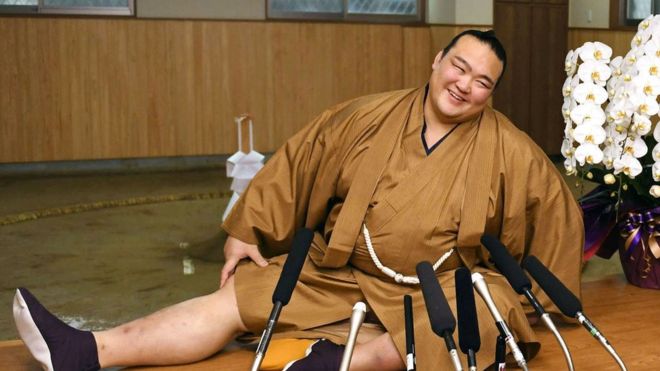
"I've finally got my hands on it (the Emperor's Cup) and the sense of pleasure hasn't changed," Kisenosato said Monday at his Tagonoura stable, ahead of the council's announcement. "It's hard to put into words but it has a nice weight to it."

"I felt a force in addition to my own strength that worked in my favor. I have never clung on in that manner in my whole life."

He then thanked his late stablemaster, former yokozuna Takanosato.

"Training was tough, but useful. Gratitude is the only word I can find," Kisenosato said. "It won't be a real payback to him if I don't train further and get stronger. He always used to say 'to be a yokozuna is lonely.' I couldn't fathom it at the time but I'll strive so I can come to understand."

"Yokozuna is a rank that carries responsibility. Defeat signals the end."

Luck was on Kisenosato's side at the New Year basho, with up-and-down Mongolian yokozuna Harumafuji and Kakuryu both withdrawing. Fellow ozeki Goeido also pulled out on the 13th day, gifting a win by default to Kisenosato.

Eight of the last nine yokozuna secured promotion by winning their preceding two tournaments. Mongolian Kakuryu was the last to be promoted to yokozuna ahead of the May 2014 meet. He lost in a playoff that January despite finishing 14-1, but won the title in March.

Hideshige Moriya, the council's chairman, had said Sunday he does not expect any panel members to oppose Kisenosato's promotion with his performance meeting the requirement of two straight titles or results as good.

So often accused of being mentally fragile, Kisenosato has finished second-best at a meet 12 times. After Kotoshokigu and Goeido captured their first titles last year, Kisenosato had become the only Japanese ozeki not to have won a trophy.

Swami
 

Swami

Telly Talk Supreme
Japan gets first sumo champion in 19 years
  • 1 hour ago
  • From the section Asia
Share
Share this with

Copy this link

http://www.bbc.co.uk/news/world-asia-38721106
Read more about sharing.
_93774876_kisenosatoreu.jpg
Image copyright Reuters
Image caption In recent years, sumo has been hit by falling numbers of Japanese recruits
Japan has formally named its first home-grown sumo grand champion in almost two decades, in a boost to the traditional wrestling sport.

Kisenosato, 30, was promoted to the top-most yokozuna rank after his win in the first tournament of the year.

He is the first Japanese-born wrestler to make it since Wakanohana in 1998. Five wrestlers from American Samoa and Mongolia have made it in the interim.

Foreign wrestlers have come to dominate sumo, amid a lack of local recruits.

Kisenosato, who comes from Ibaraki to the north of Tokyo and weighs 178kg (392 pounds), has been an ozeki - the second-highest rank - since 2012.


After being runner-up on multiple occasions, he finally clinched his first tournament victory - and thereby his promotion to yokozuna - in the first competition of 2017.

"I accept with all humility," Kisenosato said in a press conference after the Japan Sumo Association formally approved him.

"I will devote myself to the role and try not to disgrace the title of yokozuna."

What is sumo?
_93774879_gettyimages-51639621.jpg
Image copyright AFP
Image caption Wakanohana (R), seen here fighting Hawaiian Akebono, was the last Japanese wrestler to be promoted to yokozuna
  • Japan's much-loved traditional sport dates back hundreds of years.
  • Two wrestlers face off in an elevated circular ring and try to push each other to the ground or out of the ring.
  • There are six tournaments each year in which each wrestler fights 15 bouts.
  • Wrestlers, who traditionally go by one fighting name, are ranked and the ultimate goal is to become a yokozuna.
Many Japanese fans will be pleased to see a local wrestler back at the top of a sport regarded as a cultural icon.

As yokuzuna, Kisenosato, whose real name is whose real name is Yutaka Hagiwara, joins three other wrestlers in sumo's ultimate rank - Hakuho, Harumafuji and Kakuryu.

The trio all come from Mongolia, following a path forged by sumo bad-boy Asashoryu, who was Mongolia's first yokozuna in 2003.

The last Japanese-born wrestlers to reach the top were brothers Takanohana and Wakanohana, who made it to yokozuna in 1994 and 1998 respectively.

In recent years, sumo has been hit by falling numbers of Japanese recruits, partly because it is seen as a tough, highly regimented life.

Young sumo wrestlers train in tightly-knit "stables" where they eat, sleep and practise together and are sometimes subjected to harsh treatment in the belief that it will toughen them up.

In 2009, a leading coach was jailed for six years for ordering wrestlers to beat a young trainee who later died, in a case that shocked the nation.

Those at the top of the sport are also expected to be role models, showing honour and humility - and can be criticised if they get it wrong.

_93774881_gettyimages-96441950.jpg
Image copyright Getty Images
Image caption Mongolian wrestler Asashoryu led the sport for many years, but sumo elders were troubled by some of his behaviour
Sumo must also compete with the rising popularity of football and baseball, which have vibrant leagues that draw crowds of young Japanese fans.

But the sport is attractive to wrestlers from other nations, who can earn a good living. Wrestlers have come from Estonia, Bulgaria, Georgia, China, Hawaii and Egypt, as well as Mongolia and American Samoa.

As a child, Kisenosato was a pitcher in his school's baseball club before he chose to train as a wrestler at a stable in Tokyo.

He made his debut in 2002 and, reported Japan's Mainichi newspaper, the 73 tournaments he took to become a yokozuna are the most by any wrestler since 1926.

Speaking to reporters after the tournament victory on Monday that sealed his elevation, Kisenosato said he was pleased to be holding the Emperor's Cup trophy at last.

"I've finally got my hands on it and the sense of pleasure hasn't changed," he said. "It's hard to put into words but it has a nice weight to it."

Swami
 

Swami

Telly Talk Supreme
Kisenosato formally promoted as sumo's 72nd yokozuna
Details
Details
Created on Wednesday, 25 January 2017 12:56
Written by Kyodo
Kisenosato%20promocion%20yokozuna.jpg


Kisenosato officially became the 72nd grand champion in sumo history on Wednesday after the Japan Sumo Association finalized his promotion at its executive committee meeting.

JSA executives rubber-stamped the promotion of the 30-year-old Kisenosato based on the recommendation unanimously made Monday by members of the Yokozuna Deliberation Council, an advisory body to the association, after he won his maiden title at the New Year Grand Sumo Tournament.

"I accept (the promotion) with great humility. I will devote myself and try not to disgrace the yokozuna name," Kisenosato said in a formal ceremony to notify him of his promotion.

"I want to be even more focused," he said after the ceremony. "I have grown also as a person and I want to become a yokozuna that is respected. I have to be conscious (of my position) and winning the championship title at the next tournament (is my next goal)," he said.

Kisenosato becomes the first Japanese wrestler to be promoted to sumo's top rank of grand champion since Wakanohana in 1998. Kisenosato won his first championship title on Sunday with a 14-1 mark.

Eight of the last nine yokozuna secured promotion by winning their preceding two tournaments. Mongolian Kakuryu, the last to be promoted to yokozuna ahead of the May 2014 meet, lost in a playoff that January despite finishing 14-1, but won the title in March.

So often accused of being mentally fragile, Kisenosato has finished second-best at a meet 12 times. After Kotoshokigu and Goeido captured their first titles last year, Kisenosato had become the only Japanese ozeki not to have won a trophy.

But Kisenosato found consistency and finally came into his own in 2016, becoming the first wrestler to win the most bouts in a season without winning a single title.

"I feel grateful to all the people that have helped me," said Kisenosato, who paid tribute to his late stablemaster Naruto. "If I had not met my former trainer I would not have got to where I have now," he said. "I have nothing but gratitude."

Mongolian Kakuryu was the last wrestler promoted to yokozuna in 2014.

There will now be four wrestlers fighting as yokozuna for the first time in 17 years at the Spring meet in March.

Swami
 

Swami

Telly Talk Supreme
I watch a lot of NHK news/programs and pick-up their recent sumo coverage. Impressive win here. We'll see how he does in Osaka in March.

Some debate as to whether promotion was deserved or not but his consistency over the last year would suggest well-deserved.

Eras of four yokozuna don't last long though so expect at least one of the other three - probably Hakuho - to retire before end of year.

Swami
 

Swami

Telly Talk Supreme
Yokozuna Kisenosato performs first ring-entry ceremony
Details
Details
Created on Saturday, 28 January 2017 14:12
Written by Kyodo
Kisenosato%20primer%20yokozuna%20dohyoiri.jpg


New yokozuna Kisenosato performed his first ring-entry ceremony on Friday before a large crowd of around 18,000 at Tokyo's Meiji Shrine.

"I'm relieved it ended without trouble," the 30-year-old said after making his ceremonial debut as yokozuna. "I came with a sense of gratitude and wanted everyone to see powerful figure. I focused on being relaxed, making myself big and carrying it out with strength."

"I'm grateful so many people saw it. I concentrated from head to toe," said Kisenosato, who attracted the second-largest audience to the ceremony following Takanohana's 20,000 in November 1994.

The first Japanese native to be promoted to the sport's highest rank of grand champion since 1998, the Tagonoura stable star was accompanied in the ceremony by fellow wrestlers Takayasu and Shohozan.

Kisenosato revealed he had been watching the footage of former yokozuna with the unryu style -- one of two styles for the ritual -- and practiced through late night on Thursday to master the procedure.

JSA Chairman Hakkaku, former yokozuna Hokutoumi, acknowledged the support from the fans as well as the imposing performance from Kisenosato.

"I'm overwhelmed with so many people in attendance. I'm really glad to have been associated with sumo, I was moved," Hakkaku said. "His movement was smooth because he has a flexible lower back. That's why he's strong, too."

"I hope he takes encouragement from this (large crowd) rather than as a load to be carried."

Kisenosato's parents were also in attendance.

"It's finally sunk in that he has become a yokozuna," said his father, Sadahiko Hagiwara. "It feels as if he's no longer my child. He has completely left our hands."

Kisenosato's promotion on Wednesday, after his first career championship at this month's New Year Grand Sumo Tournament, gives the sport four active yokozuna alongside the Mongolian trio of Hakuho, Harumafuji and Kakuryu.

"There has never been a week as full as this in the past 15 years (since my debut)," Kisenosato said. "I won't forget it the rest of my life. The sense of responsibility will grow even bigger. I really think it's all starting here."4

Swami
 
Top