- Awards
- 28
A View To A Kill (1985)
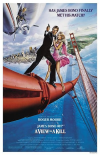
"Has James Bond finally met his match?" falsely hints at the termination of the beloved character and his film adventures.
But, as it happens with the various interpretations of The Doctor, this will be final curtain for Roger Moore in the role of the British Secret Service agent.
In the first act he teams up with another agent played by Patrick Macnee and these scenes have a pleasant Holmes & Watson vibe.
A scheme with racehorses reveals the disturbing background of A View's super-villain Max Zorin played by the actor with the strangest hair - regardless of the colour - Christopher Walken.
Grace Jones plays his deadly henchwoman May Day, possibly inspired by non-EON Bond assassinette Fatima Blush.
Apparently, Dolph Lundgren is in it too but I didn't spot him.
As expected there's an abundance of spectacle and chase scenes and I'm sure it looks even better on the big screen.
The ski chases are becoming a bit stale now and the escape in the fire engine is pretty awful (not to mention the J.W. Pepper knockoff) but there's also a zeppelin disaster and I just happen to love zeppelins.
Tonally it's closer to For Your Eyes Only than to Octopussy, which is definitely a good thing. There's nothing in it that makes the story drag and it's pretty much high-octane from start to finish without being hysterical.
The violence seems a bit glorified even by Bond standards but I guess that's part of the development of the film series. It always needs to be a bit more...something.
I could point out (once again) Roger Moore's visible aging, but Moore himself was very aware of that and in later interviews he displayed a healthy dose of self-mockery (which I always find a very British thing to do).
I believe his last two roles as 007 was a matter of loyalty to the Bond Team rather than the desire to keep playing 007.
It's true that none of that should concern the viewers because they are paying for the end result.
All things considered I think Moore gave it his best shot and let's not forget that our perception of age has changed a lot over the years.
Today, 58 is the new 38 and it's perfectly all right for these actors to play the romantic action-hero type.
Ranking the Connery/Lazenby/Moore years:
1. From Russia With Love + On Her Majesty's Secret Servive
Impossible to choose because they're both the best for different reasons.
2. Thunderball
3. Goldfinger
4. Dr. No
5. Diamonds Are Forever
6. Live And Let Die
7. Moonraker
8. Never Say Never Again
9. For Your Eyes Only
10. A View To A Kill
11. The Man With The Golden Gun
12. The Spy Who Loved Me
13. You Only Live Twice
14. Octopussy
Roll on 007 #4 (I think I've watched these two films only once and have virtually no memory of it. How exciting!)
One of those fabulous modern trailers:
"Has James Bond finally met his match?" falsely hints at the termination of the beloved character and his film adventures.
But, as it happens with the various interpretations of The Doctor, this will be final curtain for Roger Moore in the role of the British Secret Service agent.
In the first act he teams up with another agent played by Patrick Macnee and these scenes have a pleasant Holmes & Watson vibe.
A scheme with racehorses reveals the disturbing background of A View's super-villain Max Zorin played by the actor with the strangest hair - regardless of the colour - Christopher Walken.
Grace Jones plays his deadly henchwoman May Day, possibly inspired by non-EON Bond assassinette Fatima Blush.
Apparently, Dolph Lundgren is in it too but I didn't spot him.
As expected there's an abundance of spectacle and chase scenes and I'm sure it looks even better on the big screen.
The ski chases are becoming a bit stale now and the escape in the fire engine is pretty awful (not to mention the J.W. Pepper knockoff) but there's also a zeppelin disaster and I just happen to love zeppelins.
Tonally it's closer to For Your Eyes Only than to Octopussy, which is definitely a good thing. There's nothing in it that makes the story drag and it's pretty much high-octane from start to finish without being hysterical.
The violence seems a bit glorified even by Bond standards but I guess that's part of the development of the film series. It always needs to be a bit more...something.
I could point out (once again) Roger Moore's visible aging, but Moore himself was very aware of that and in later interviews he displayed a healthy dose of self-mockery (which I always find a very British thing to do).
I believe his last two roles as 007 was a matter of loyalty to the Bond Team rather than the desire to keep playing 007.
It's true that none of that should concern the viewers because they are paying for the end result.
All things considered I think Moore gave it his best shot and let's not forget that our perception of age has changed a lot over the years.
Today, 58 is the new 38 and it's perfectly all right for these actors to play the romantic action-hero type.
Ranking the Connery/Lazenby/Moore years:
1. From Russia With Love + On Her Majesty's Secret Servive
Impossible to choose because they're both the best for different reasons.
2. Thunderball
3. Goldfinger
4. Dr. No
5. Diamonds Are Forever
6. Live And Let Die
7. Moonraker
8. Never Say Never Again
9. For Your Eyes Only
10. A View To A Kill
11. The Man With The Golden Gun
12. The Spy Who Loved Me
13. You Only Live Twice
14. Octopussy
Roll on 007 #4 (I think I've watched these two films only once and have virtually no memory of it. How exciting!)
One of those fabulous modern trailers: