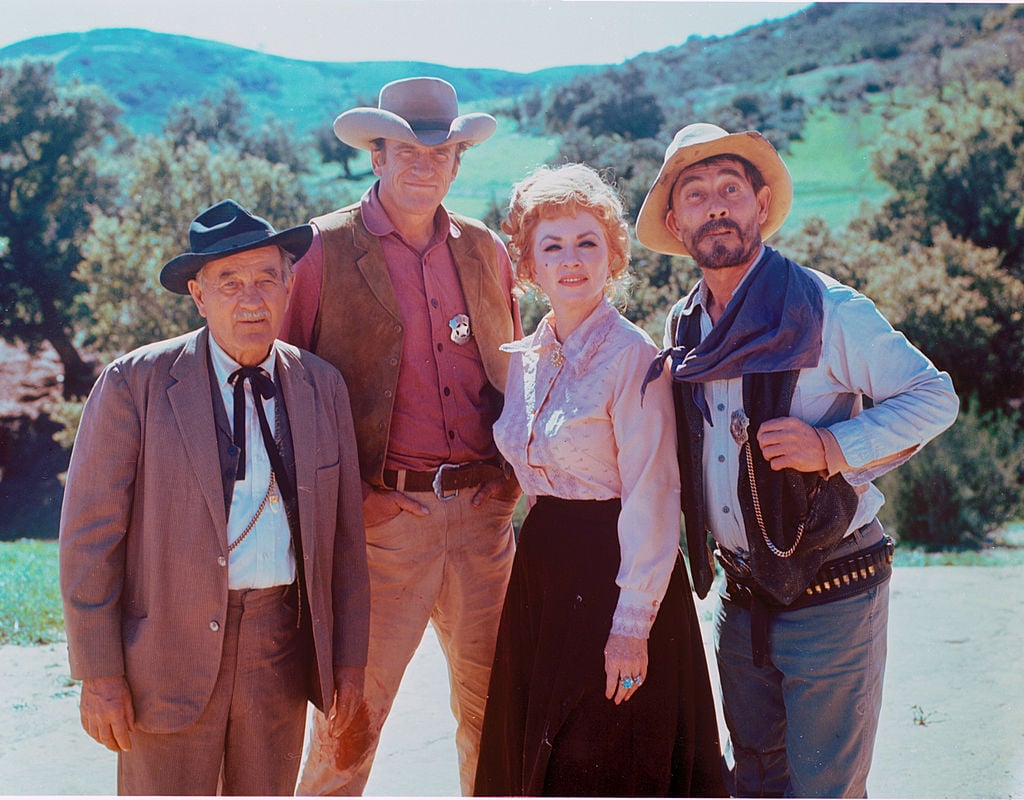
GUNSMOKE ended after a phenomenal twenty-year run, and was cancelled for the third and final time in 1975.
Even in its 20th (and final) year, the first half of that season was some of the best back-to-back western episodes in all of TV history, the show still in the weekly Top 10 (once hitting #5 for "The Wiving" episode, despite the absence of Kitty for whom the script was obviously written). At least, while future DALLAS mentor Leonard Katzman was still producing GUNSMOKE's twentieth season, that first half.
But Katzman left mid-way through the twentieth season to go produce PETROCELLI (GUNSMOKE started shooting each season months before other series, thus he could leave mid-season from GUNSMOKE and still have PETROCELLI ready-to-air by September). Also, there were rumblings of friction between Katzman and executive producer, John Mantley (after returning to DALLAS when Pam woke up in 1986, Katzman said, "I've been fired before -- it's worth it.") Also, Mantley not only nudged Katzman out, he essentially fired Amanda Blake after 19 years on the show, because the actress didn't want Kitty brutally raped-and-beaten in the two-parter "Guns of Cibola Blanca" so soon just two years after the "Hostage!" episode where the same thing had happened to her. Mantley later sneered in an interview that Blake "complained about everything" (which Blake, ever-the-gracious-gal, conceded). Oh, but those Scorpio Risings -- can't they ever get along??
Anyway, once Katzman was gone (after "The Colonel" episode midway through Season 20), a new line producer was brought in, John J. Stephens, who, while competent, changed the tone significantly for the last half of the season: GUNSMOKE became too ponderous too consistently, and ratings started to tumble. By the end of the 1974/75 season, GUNSMOKE averaged at #29 in the ratings (a number good enough to keep most series on the air, but the death knell for a show always expected to be in the Top 10). And given that GUNSMOKE was in the weekly Top 10 for the first half of its twentieth season, it had to fall pretty far pretty fast to average out at only #29 for the year -- everybody just switched over to THE ROOKIES.
The network executives at CBS took this opportunity to cancel GUNSMOKE for the third and final time ("some horse-feathers about demographics," James Arness grumbled in the press) and this time William Paley didn't override the decision. The audience was getting grey around the temples, and advertizers believed only nineteen-year-old girls ever buy anything (which is not entirely un-true).
So gargantuan GUNSMOKE, after two decades, was gone due to only a brief slip in the Nielsens.
From what I've read, Lucille Ball wanted to end HERE'S LUCY in 1972 because she saw the new coming aboard the TV landscape. But it was then-President of CBS, Fred Silverman, who persuaded her to stay another two years. Her show was still in the Top 10 in 1972 and it's likely that Silverman felt there was still more to squeeze out of America's favorite redhead. It might also be possible that CBS had nothing ready to replace HERE'S LUCY with at the time.
Yes, Lucy apparently was burned out after 23 years as the queen of television. You can't blame her. HERE'S LUCY was an obvious retread (although I watched it) and one can understand why she didn't want to do it anymore. I mean, she was in her sixties, she'd sold Desilu to Paramount six years earlier... she probably needed a break... Even histrionic divas need a rest, too, after a while.
But
@Crimson is quite right: the formulaic TV of the '60s, though it fit in with the Huge Wood Console & Gold Drapes Gothic sensibility of the American living room of the decade, had become tired... I'm old enough to remember that -- and to almost even "get" that sense of small-screen fatigue... But whatever the brass' agenda was (e.g., desire for urban demographics, deadening creative repetition) the rise of the ALL IN THE FAMILYs and MARY TYLER MOOREs was a godsend.
There had been a claw-your-neck angsty-ness about television in the late-'60s that stemmed from the muzzled rigidity that controlled it -- where the topicality and the tone weren't allowed to reflect what was really going on in the culture of that period. Almost at all. Except for some of the clothes and a little of the music.