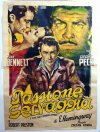
In 1947's The Macomber Affair (United Artists), Joan Bennett gave one of her most acidic portrayals of deceit and being just plain despicable. The Macomber Affair is a perfectly mastered mystery with an unforgettable femme-fatale in Joan Bennett's Margaret Macomber, and its also a fine example of what really can motivate you in order to propel the viewer into questioning exactly what happened on safari. As more information is revealed you find out that the relationship between the Macomber's was troubled, to say the least and the grounds for divorce were there. For many years that included infidelity, battery, and both Macomber's continue to hold a consistent level of disdain, hatred, and possibly love for one another. The Macomber Affair is not a love story to remember, but a twisted mystery about a couple whose problems surface, culminating in one of them dying, while in the midst of the African desert, among them a handsome guide whose relationship with the couple is far from innocent. The characters are pure Hemingway, with Gregory Peck and Robert Preston representing the ideal masculine male who is courageous and unable to be controlled or manipulated. Wilson may fall in love with Margaret Macomber but she does not control him; a stark contrast to the manipulative hold she has over her husband. Wilson is what Margret Macomber wished he were, and what Margaret Macomber is presumed to wish her husband was as well, yet when Margret Macomber strikes back and develops fortitude his untimely end comes quickly. The complicated relationships between the characters and their mixed and constantly changing motivations keep The Macomber Affair interesting, while adding thrills from the hunt--deadly thrills.
The plains of Africa are shot beautifully by Cinematographer Karl Struss, showcasing the natural movement of the animals. Lions and giraffes run free on the land, as the characters pass by in their jeep, marveling at the beauty of the plain. There are striking tracking shots taken along with the game, and on a full-frame scale they envelope the frame with movement. The violence of the hunt takes over the characters emotions and reflections and also affects the viewer. In 1947 our culture approached it differently, and that makes The Macomber Affair a fascinating look at the changing perspectives in cinematic acceptance.
What was once deemed normal and not offensive now has a completely different effect. The film is more intense because the scenes of the hunt are shown, instead of hidden away behind edits.
It may be one of the best Hemingway stories on film, though it’s not without its troubles as a movie. First published in Cosmopolitan Magazine in 1936, “The Short, Happy Life of Francis Macomber” explored the disintegration of a marriage, as well as the themes of fear, death, and sexuality that were constants in the writer’s works. Based at least in part on an incident on an actual event during safari that Hemingway may have learned from his friends and African hunters Philip Percival or Baron Bror on Blixen, the characters may have been based on actual people, but the story is compelling on its own terms.
The story concerns Robert Wilson (Gregory Peck) who escorts a moneyed American couple (Robert Preston & Joan Bennett) on a safari in Kenya, the wife, it becomes clear, loathes hunting almost as much as her husband, and even herself, scoffing at them as they chase “some helpless animals in a motor car. The underlying tensions of the triangle that forms among these people becomes clearer after the title character, Francis Macomber, disgraces himself by running away while pursuing a lion with Wilson. His humiliation is complete after his fuming wife, Margaret, brazenly kisses the dumbfounded hunting guide in front of her shattered husband. The journey, it becomes clear, is not so much a pursuit of wild animals and a test of skill, but a test of wills. The scales of power in the married couple’s relationship, already frayed by the wife’s past infidelities and the husband’s outward swagger compensating for his own sense of his inadequacy, wavers further as they torment one another. Francis Macomber, an insecure man who knows that his wife is only with him because of his money, finds himself haunted by a sense of fear when he hears a lion’s roar in the night, eroding any sense of self-worth further.
Joan Bennett, did her best work in the 1940s, beginning with her appearance in director Fritz Lang’s Man Hunt (1941, 20th Century-Fox) and continuing through The Woman in the Window (1944, RKO) and Scarlet Street (1945, Universal) as well as The Secret Beyond the Door (1948, Universal). Never given her full due as an actress, she was more than a film noir femme fatale, and her work with Lang as well as Jean Renoir in The Woman on the Beach (1947, RKO) Max Ophuls in The Reckless Moment (1949, Columbia) and her comedic work with Raoul Walsh and Vincente Minnelli–not to mention her early role as Amy in George Cukor’s Little Women (1933, RKO) makes her career deserving of a true retrospective.
Using her dark, rather sulky beauty and soft, yet brittle voice to convey her gift for off-hand, silken sarcasm to indicate this unhappy creature’s boldness was probably easy for the actress by this time. Bennett gets a great deal of mileage out of Margaret. Bennett was always at her best as a conflicted character here as a woman turned into a cold-hearted character by a bad marriage though subtle gestures and sly looks she gives the film a tough grounded center and she has rarely looked so beautiful. Margaret Macomber’s needling of her mate, bringing a touch of humor to the story. When being served meat at the dining table in their tent on the day when her husband has proven himself a coward, she brightens visibly and Wilson comments that she’s “very merry.”
What was unexpected about Joan Bennett‘s performance was the manner in which her mood changes, from bitchy gayness to cold rage to melancholy despair, expressed her character’s sense of futility over the miserable existence she, as well as her husband, knew that they had created for each other in their marriage. Despite that tacked-on ending that was, according to Gregory Peck, “the best they could to do,” given the Production Code's requirements of the time (and Hemingway‘s silent refusal to write an alternate ending), her bleak expression and tortured realization that even she is unsure if she shot her husband by accident or by design.
Second lead actress Jean Gillie had been brought to the United States by her husband Jack Bernhard. They married in 1944 but divorced in 1947. Jean Gillie returned to Britain and before she could restart her career back home she died at age 33 on February 19, 1949 from pneumonia.
The plains of Africa are shot beautifully by Cinematographer Karl Struss, showcasing the natural movement of the animals. Lions and giraffes run free on the land, as the characters pass by in their jeep, marveling at the beauty of the plain. There are striking tracking shots taken along with the game, and on a full-frame scale they envelope the frame with movement. The violence of the hunt takes over the characters emotions and reflections and also affects the viewer. In 1947 our culture approached it differently, and that makes The Macomber Affair a fascinating look at the changing perspectives in cinematic acceptance.
What was once deemed normal and not offensive now has a completely different effect. The film is more intense because the scenes of the hunt are shown, instead of hidden away behind edits.
It may be one of the best Hemingway stories on film, though it’s not without its troubles as a movie. First published in Cosmopolitan Magazine in 1936, “The Short, Happy Life of Francis Macomber” explored the disintegration of a marriage, as well as the themes of fear, death, and sexuality that were constants in the writer’s works. Based at least in part on an incident on an actual event during safari that Hemingway may have learned from his friends and African hunters Philip Percival or Baron Bror on Blixen, the characters may have been based on actual people, but the story is compelling on its own terms.
The story concerns Robert Wilson (Gregory Peck) who escorts a moneyed American couple (Robert Preston & Joan Bennett) on a safari in Kenya, the wife, it becomes clear, loathes hunting almost as much as her husband, and even herself, scoffing at them as they chase “some helpless animals in a motor car. The underlying tensions of the triangle that forms among these people becomes clearer after the title character, Francis Macomber, disgraces himself by running away while pursuing a lion with Wilson. His humiliation is complete after his fuming wife, Margaret, brazenly kisses the dumbfounded hunting guide in front of her shattered husband. The journey, it becomes clear, is not so much a pursuit of wild animals and a test of skill, but a test of wills. The scales of power in the married couple’s relationship, already frayed by the wife’s past infidelities and the husband’s outward swagger compensating for his own sense of his inadequacy, wavers further as they torment one another. Francis Macomber, an insecure man who knows that his wife is only with him because of his money, finds himself haunted by a sense of fear when he hears a lion’s roar in the night, eroding any sense of self-worth further.
Joan Bennett, did her best work in the 1940s, beginning with her appearance in director Fritz Lang’s Man Hunt (1941, 20th Century-Fox) and continuing through The Woman in the Window (1944, RKO) and Scarlet Street (1945, Universal) as well as The Secret Beyond the Door (1948, Universal). Never given her full due as an actress, she was more than a film noir femme fatale, and her work with Lang as well as Jean Renoir in The Woman on the Beach (1947, RKO) Max Ophuls in The Reckless Moment (1949, Columbia) and her comedic work with Raoul Walsh and Vincente Minnelli–not to mention her early role as Amy in George Cukor’s Little Women (1933, RKO) makes her career deserving of a true retrospective.
Using her dark, rather sulky beauty and soft, yet brittle voice to convey her gift for off-hand, silken sarcasm to indicate this unhappy creature’s boldness was probably easy for the actress by this time. Bennett gets a great deal of mileage out of Margaret. Bennett was always at her best as a conflicted character here as a woman turned into a cold-hearted character by a bad marriage though subtle gestures and sly looks she gives the film a tough grounded center and she has rarely looked so beautiful. Margaret Macomber’s needling of her mate, bringing a touch of humor to the story. When being served meat at the dining table in their tent on the day when her husband has proven himself a coward, she brightens visibly and Wilson comments that she’s “very merry.”
What was unexpected about Joan Bennett‘s performance was the manner in which her mood changes, from bitchy gayness to cold rage to melancholy despair, expressed her character’s sense of futility over the miserable existence she, as well as her husband, knew that they had created for each other in their marriage. Despite that tacked-on ending that was, according to Gregory Peck, “the best they could to do,” given the Production Code's requirements of the time (and Hemingway‘s silent refusal to write an alternate ending), her bleak expression and tortured realization that even she is unsure if she shot her husband by accident or by design.
Second lead actress Jean Gillie had been brought to the United States by her husband Jack Bernhard. They married in 1944 but divorced in 1947. Jean Gillie returned to Britain and before she could restart her career back home she died at age 33 on February 19, 1949 from pneumonia.