Lucille Ball: The First Lady of Comedy

Crimson

Telly Talk Enthusiast
LV
2
 
Awards
9
I don't think she aged very well. Those cigarettes eventually caught up with her and she aged prematurely.

Off camera, sure. Even as far back as the late 40s, candid pictures show Lucy looking prematurely aged. Cigarettes and the California sun took their toll on her. On camera, she could almost always drop 10 to 15 years with heavy makeup and good lighting. It wasn't until she was in her 70s that she could no longer maintain the illusion of late middle age.
 

ClassyCo

Telly Talk Warrior
LV
5
 
Awards
11
Off camera, sure. Even as far back as the late 40s, candid pictures show Lucy looking prematurely aged. Cigarettes and the California sun took their toll on her. On camera, she could almost always drop 10 to 15 years with heavy makeup and good lighting. It wasn't until she was in her 70s that she could no longer maintain the illusion of late middle age.
You said the truth of it here. Lucy hid behind makeup and camera tricks to disguise her age. Maybe that's why she was always referred to as a "girl" on her shows?
 

Crimson

Telly Talk Enthusiast
LV
2
 
Awards
9
Aside from I LOVE LUCY and THE LUCY-DESI COMEDY HOUR, Lucy Ricardo has two other canonical appearances: THE DANNY THOMAS SHOW and THE ANN SOTHERN SHOW (both 1959).


Ann's show was one of the oddly mild series of the era that were more situation than comedy, which isn't disguised at all by the heavy canned laughter. Lucille looked rather matronly in the episode and, whenever faced with weak material, tended to be too pushy with her comedy; she's downright grating at times. On the plus side, Ann & Lucille had good on screen chemistry.


THE DANNY THOMAS SHOW episode is better, although not as good as the earlier crossover on the LUCY-DESI show. The episode also contains a surprisingly important key to the Ricardo's relationship. We find out here that Ricky loved Lucy because of her eccentricities not in spite of them. For all of his fiery exasperation about her schemes, he liked the excitement she brought to their marriage. That's sweet -- and maybe kind of kinky.
 

Snarky Oracle!

Telly Talk Supreme
LV
8
 
Awards
21
Aside from I LOVE LUCY and THE LUCY-DESI COMEDY HOUR, Lucy Ricardo has two other canonical appearances: THE DANNY THOMAS SHOW and THE ANN SOTHERN SHOW (both 1959).


Ann's show was one of the oddly mild series of the era that were more situation than comedy, which isn't disguised at all by the heavy canned laughter. Lucille looked rather matronly in the episode and, whenever faced with weak material, tended to be too pushy with her comedy; she's downright grating at times. On the plus side, Ann & Lucille had good on screen chemistry.


THE DANNY THOMAS SHOW episode is better, although not as good as the earlier crossover on the LUCY-DESI show. The episode also contains a surprisingly important key to the Ricardo's relationship. We find out here that Ricky loved Lucy because of her eccentricities not in spite of them. For all of his fiery exasperation about her schemes, he liked the excitement she brought to their marriage. That's sweet -- and maybe kind of kinky.

My, how different Lucy Ricardo is away from the apartment or the country house.

Frankly, I'm always suspicious when any series changes its title.
 
Last edited:

Crimson

Telly Talk Enthusiast
LV
2
 
Awards
9
how different Lucy Ricardo is away from the apartment of the country house.

Those two episodes were made around the time of the final LUCY-DESI hourlong shows. Those final specials were dreadful for a number of reasons, but particularly notable that neither Lucy nor Viv seemed really able to get into character. While Vivian resentfully gave up any semblance of playing Ethel Mertz, Lucille seemed to be doing an early draft of Lucy Carmichael.
 

ClassyCo

Telly Talk Warrior
LV
5
 
Awards
11
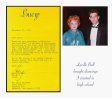
On this I LOVE LUCY fan page on Facebook, this individual shared his experience with Lucille Ball. He had some drawings that Lucy purchased from him and this is the letter he received from her.

Isn't this cool?

1000008116.jpg
 

Crimson

Telly Talk Enthusiast
LV
2
 
Awards
9
When the Burton diaries were published in the 80s, Lucy's family had tried to keep the book from her; they had heard that Richard raked her across the coals. Lucy got her hands on the book and was allegedly quite hurt, not really understanding why Burton disliked working with her.

Every star Lucy clashed with on her show was someone who didn't live up to her (probably unrealistic) expectation of professionalism. They were either inebriated (Bankhead, Crawford) or not up to the rigors of producing a show in 4 days. The later seemed to be the case with Dick; and maybe Liz too. Compared to the leisurely pace of movie filming or lengthy Broadway rehearsals, Lucy's show was produced quickly and she expected fast results. It's a safe assumption Liz & Dick agreed to do the show because they thought it would be a romp. But Lucy didn't run her show like Dean Martin, where celebrities could have a few drinks and read off queue cards. When Burton was giving a mumbly, lazy performance in rehearsals, Lucy 'coached' him and probably none to tactfully. That's apparently what triggered Burton's resentful recollection in his journal.

In 1976, Burton appeared on a TV special testimonial to Lucy, so he apparently didn't hate her that much.
 

Caryscott

Telly Talk Active Member
LV
0
 
Awards
2
How long before A.I. celebrity voices start confessing to sex crimes and rococo political assassination plots?
Based on the new Lou Perlman doc on Netflix the time is now. They stick to filling him with pearls of wisdom from his book but how long can that restraint last? It’s pretty convincing, they have come along way since Mr. Ed.
 

Caryscott

Telly Talk Active Member
LV
0
 
Awards
2
I doubt Lucy was perfect. Control is usually the issue for a lot of women of that era. Even when they had it they didn’t. So aggressively asserting it often became the only way they could exercise their power. Historical accounts often filtered through the recollection of men are notoriously unreliable. There is that great television interview where the male host is out in the audience and Lucy keeps telling to him to stop pawing the female audience members. She’s insistent but not mean. I’m sure she got it wrong sometimes, we all do, but she seems pretty authentic to me. Ahistorical one dimensional portraits of female stars whether a white wash or hatchet job are the dullest.
 

Crimson

Telly Talk Enthusiast
LV
2
 
Awards
9
Historical accounts often filtered through the recollection of men are notoriously unreliable. There is that great television interview where the male host is out in the audience and Lucy keeps telling to him to stop pawing the female audience members. She’s insistent but not mean. I’m sure she got it wrong sometimes, we all do, but she seems pretty authentic to me. Ahistorical one dimensional portraits of female stars whether a white wash or hatchet job are the dullest.

I've read a lot of biographies of Lucy -- most of them, probably -- and often the same incidents are recounted from different vantage points or by different people; this often adds context and perspective to recollections. There's an incident included in many biographies of Jack Benny guesting on HERE'S LUCY; as most versions go, Lucy was awfully rough on Jack, bordering on outright cruelty. These accounts always struck me as odd. Jack was Lucy's next door neighbor. She respected and adored him. A later book (the excellent "The Lucy Book") included a recount of the event by Jack's agent, who was on set for filming. He dismissed the other accounts, saying they were misconstrued; Lucy & Jack were engaging in gruff verbal sparring like two old cronies and that Jack wasn't the least bit offended.

Which isn't to say Lucy couldn't be tough to work with; I'm sure she was. But those accounts often miss context. The actors she clashed with were usually unprofessional (Bankhead) or not performing well (Crawford; Burton).

People are complicated and Lucy was no exception. She was a devoted daughter, yet a distant mother. She maintained friendships for 50+ years, but also cut people out of her life for minor infractions. She was exceptionally friendly to her fans, yet rude to servers. The temptation to reduce a person to a specific stereotype ("she was a bitch", "she was a sociopath") is overly simplistic.
 
Last edited:

DallasFanForever

Telly Talk Supreme
LV
5
 
Awards
17
A belated and Happy 113th Birthday to Lucille Ball! Will never forget being a child in the 1980s and flipping the channels to find reruns of this little show called I Love Lucy. Also won’t forget my grandparents getting a real kick out of the fact that I was watching shows that they had watched over three decades earlier.
 

Soaplover

Telly Talk Fan
LV
0
 
Awards
3
I doubt Lucy was perfect. Control is usually the issue for a lot of women of that era. Even when they had it they didn’t. So aggressively asserting it often became the only way they could exercise their power. Historical accounts often filtered through the recollection of men are notoriously unreliable. There is that great television interview where the male host is out in the audience and Lucy keeps telling to him to stop pawing the female audience members. She’s insistent but not mean. I’m sure she got it wrong sometimes, we all do, but she seems pretty authentic to me. Ahistorical one dimensional portraits of female stars whether a white wash or hatchet job are the dullest.
Dismissing an account because it's coming from men is no better then dismissing women for asserting control on their show.
 

ClassyCo

Telly Talk Warrior
LV
5
 
Awards
11
@ClassyCo It's a great book and the best on Lucy's TV career as a whole. I might need to buy a new one soon. Mine is getting awfully dog -eared.
I am totally excited to finally own it myself. I have seen you reference it so many times. Geez, Wikipedia even references it often.

The copy I bought says it was in "good" condition, so here's hoping that it's good enough for me to keep a while.
 

Caryscott

Telly Talk Active Member
LV
0
 
Awards
2
Dismissing an account because it's coming from men is no better than dismissing women for asserting control on their show.
I was clear that I was speaking about “historical” accounts and used the word “often” not always. Crimson’s post aptly verifies the veracity of my observation in this instance. In my experience men of this or any era are not delicate flowers that need to be shielded from criticism or accountability. Infantilizing them as a whole isn’t useful and only serves to obscure the agency and success of women lake Lucille Ball, Ann Southern, Loretta Young, Jane Wyman and others achieved as early television producers with the support of some key men and despite others. Acknowledging the bad only makes the admirable conduct of Desi Arnaz and William Asher stand taller.
 
Top