Lucille Ball: The First Lady of Comedy

Crimson

Telly Talk Enthusiast
LV
2
 
Awards
9
A pretty good, new documentary on Lucy's life & career aired on Reelz. Nothing new was covered, although, at this point, I'm not sure what could be new in a life so well documented already; also a few wrong-ish facts. But some good commentary and observations from Carol Burnett, Lily Tomlin, Suzanne Somers and Debra Messing.
 

ClassyCo

Telly Talk Warrior
LV
5
 
Awards
11
I've been watching what episodes of THE LUCY SHOW that's available on Hulu. There's around 75 or so of them, I think, naturally from all six seasons. While these shows are beautifully restored (some of those season two and three episodes are absolutely gorgeous), but I've noticed a few things along the way.

Lucy worked her best when Ricky, Ethel, and Fred were by her side. That type of zany character was at its best with three more level-headed and rational characters circling around her. THE LUCY SHOW started off really strong, especially the first black-and-white season, which basically plays like an extended of I LOVE LUCY. It's obvious that Lucy and Vivian (as their on-screen characters were also named) have a seasoned friendship, and their on-screen antics are every bit as good as they were on I LOVE LUCY.

It starts weakening when Vivian Vance started limiting her appearances on THE LUCY SHOW. Lucy toyed around with Ann Sothern for a while, who was an old friend, but negotiations about her replacing Vance eventually fell through. Joan Blondell was also in a few season four shows, but she and Lucy didn't get along and so that was scrapped. Lucy eventually fell back on Mary Jane Croft as her new sidekick, but in a much smaller and recurring capacity. Gale Gordon was ushered in as the main co-star from season four on. Those later seasons of THE LUCY SHOW are star-stuffed with a host of celebrity guest stars, and that makes things a little repetitive. Lucy and Gale Gordon worked well off one another, but their chemistry was one-note really. She did something stupid, and he hollered at her. That was about it.

Then in 1968 THE LUCY SHOW ended, but was quickly re-branded and brought back to TV as HERE'S LUCY, with Gale Gordon again as Lucy's co-star. Lucie Arnaz and Desi Arnaz Jr. were also in the mix, and even Mary Jane Croft and Vivian Vance on a recurring basis. HERE'S LUCY basically continued the trend from the last seasons of THE LUCY SHOW by bringing in a host of celebrities in guest shots. This trend was popular with audiences, but actually very limiting for Lucy and her writers. It put Lucy in a box and the episodes got stale and repetitive. Still, I'm sure I prefer HERE'S LUCY over the last two seasons of THE LUCY SHOW, probably because Lucy's kids are a part of it and especially in the final years when Lucy finally "aged" and the physical comedy was sidelined.
 

Crimson

Telly Talk Enthusiast
LV
2
 
Awards
9
I can't think of any show that declined in quality year-over-year as consistently as THE LUCY SHOW and with corresponding behind-the-scenes changes to explain the decline.

The first season is very good; not quite as good as I LOVE LUCY at its best but about on par with its average. The season has a focus and the comedy starts from plausible characters and relationships. Much of this is to the credit of Desi Arnaz. Although divorced for 2 years, Desi was still running Desilu and was the executive producer of the first 8 episodes of THE LUCY SHOW. Even after he left, the writers maintained the focus he established for the remainder of the season. This season is the last truly great work Lucy would do in her career.

Despite being a big hit, CBS executives were derisive about the series due to its lack of male stars -- one apparently called it "The Dyke Sans Dick Show". This is the reason Gale Gordon was brought in during season two. Without Desi, the writers didn't bother ironing out a good relationship between Mr. Mooney and the rest of the characters; any concept the show had became nebulous. During the same season, Lucy's belligerence towards her longtime writers caused them to quit. From that point on, her series would never again have consistent staff writers. The quality became erratic and any sense of continuity went out the window.

Vivian was miffed about the declining quality and feeling sidelined, so she left at the end of the third season. The change in direction between seasons three and four are so extreme, it feels like two different shows. Lucy, in her mid-50s, started being written has if she was a young lady and even the slightest pretense of believability was gone. As kinky as 60s TV could be, nothing is more perverse than the sight of Lucy in male drag -- a common motif in the series -- while still wearing fake eye lashes, blue eye shadow and red lipstick.

As grating and tacky as THE LUCY SHOW became, I would still take it over HERE'S LUCY which I find just about the stalest show ever made. Even the "good" episodes (the Burtons) I find to be unwatchable. I almost think I'd rather watch LIFE WITH LUCY, which at least has a kind of doomed valiance to it.
 

Snarky Oracle!

Telly Talk Supreme
LV
8
 
Awards
21

ClassyCo

Telly Talk Warrior
LV
5
 
Awards
11
I saw an interview once where she said that she started Here's Lucy to give the kids something to do.
Well, I'm sure there is some truth to that but I know she decided to end THE LUCY SHOW in 1968 because she had sold Desilu Studios to Gulf+Western sometime in 1967. Even though THE LUCY SHOW was raking in its highest Nielsen numbers during the 1967─68 season (it was #2 that year, right behind THE ANDY GRIFFITH SHOW), Lucy made it clear to CBS that she didn't want to continue in a show she no longer "owned".

CBS was naturally reluctant, but Lucille Ball wasn't about to leave television. It was her medium, the place she had done her best work. She just needed a little while to reconfigure things. What she and husband Gary Morton did was start Lucille Ball Productions and gently alter THE LUCY SHOW format into what they called HERE'S LUCY, a show CBS picked up without ever seeing a script or filming, screening, and testing a pilot. I think they agreed so fast to simply keep Lucy on television. They trusted her judgment, and things pushed right along.

There's a few different stories I've heard surrounding how Lucie Arnaz and Desi Arnaz Jr. came into the HERE'S LUCY casting pool. The most common one that I hear is the story Lucie Arnaz typically tells when she's interviewed about the show. She says that her mother wanted her and her brother on the show from the start, but they were both unsure at first. They each had other career aspirations (Lucie wanted to be a stage actress, while Desi wanted to sing and tour), but they eventually agreed to do HERE'S LUCY once their mother agreed to write them out of the show if word of mouth was negative towards their performances. Of course, we all know the kids did well enough (very well in some cases) and HERE'S LUCY had a six-season-run and enjoyed healthy ratings up until it concluded in 1974. Desi Jr. made fewer appearances after the second season, and doesn't make any appearances that final sixth season, but Lucie was there for the whole run, getting some real chances to stretch her talents when Lucy was chained to a wheelchair when she broke her leg while skiing.

I can't think of any show that declined in quality year-over-year as consistently as THE LUCY SHOW and with corresponding behind-the-scenes changes to explain the decline.

The first season is very good; not quite as good as I LOVE LUCY at its best but about on par with its average. The season has a focus and the comedy starts from plausible characters and relationships. Much of this is to the credit of Desi Arnaz. Although divorced for 2 years, Desi was still running Desilu and was the executive producer of the first 8 episodes of THE LUCY SHOW. Even after he left, the writers maintained the focus he established for the remainder of the season. This season is the last truly great work Lucy would do in her career.

Despite being a big hit, CBS executives were derisive about the series due to its lack of male stars -- one apparently called it "The Dyke Sans Dick Show". This is the reason Gale Gordon was brought in during season two. Without Desi, the writers didn't bother ironing out a good relationship between Mr. Mooney and the rest of the characters; any concept the show had became nebulous. During the same season, Lucy's belligerence towards her longtime writers caused them to quit. From that point on, her series would never again have consistent staff writers. The quality became erratic and any sense of continuity went out the window.

Vivian was miffed about the declining quality and feeling sidelined, so she left at the end of the third season. The change in direction between seasons three and four are so extreme, it feels like two different shows. Lucy, in her mid-50s, started being written has if she was a young lady and even the slightest pretense of believability was gone. As kinky as 60s TV could be, nothing is more perverse than the sight of Lucy in male drag -- a common motif in the series -- while still wearing fake eye lashes, blue eye shadow and red lipstick.

As grating and tacky as THE LUCY SHOW became, I would still take it over HERE'S LUCY which I find just about the stalest show ever made. Even the "good" episodes (the Burtons) I find to be unwatchable. I almost think I'd rather watch LIFE WITH LUCY, which at least has a kind of doomed valiance to it.
I'm inclined to agree with the majority of your opinions. Many look at the first season of THE LUCY SHOW as a continuation of I LOVE LUCY, and I can jive what that. That first season of THE LUCY SHOW is classic Lucy, even if it's something of a "step down" from what I LOVE LUCY gave us. Her Vivian Vance worked well together, and their relationship her gels effortlessly. It's beautiful how they compliment one another. It's interesting how Desi Arnaz and Lucille Ball continued a professional relationship after divorcing, and even after they each had remarried. THE LUCY SHOW started off strong and that's all to Desi's credit. He was the driving force behind I LOVE LUCY when it was on, and so he had a good sense of direction when it came to how Lucy would succeed on television.

THE LUCY SHOW was never really vacant of men, not even that first season. Dick Martin and Charles Lane were each a part of the cast, albeit as secondary characters, but I guess I can see how the network might have found it too feminine and felt the need to bring in some men. Dick Martin did well with what he was given, but his pretty much expressionless face didn't work as a "straight man" to Lucy's antics. He just grinned, but there weren't anything too animated like Desi Arnaz and Gale Gordon later gave us. Charles Lane was a good foil for Lucy, a talent he had shown in a few I LOVE LUCY episodes. The issue with Charles Lane wasn't his character or the writing, but his fear of performing before an audience. He and Lucy got along well and she apparently wanted to keep him around, but his sometimes paralyzing stage fright and inability to remember his lines eventually caused her to bring in Gale Gordon to replace him. (I've also heard that Lucy originally wanted Gale Gordon, but he was initially unavailable, so Charles Lane was just "filler" until Gale Gordon was free.) Either way, Charles Lane ended up moving over to PETTICOAT JUNCTION, where he played Homer Bedloe, the stick-in-the-mud that was always trying to shut the Hooterville Cannonball down.

The second and third seasons of THE LUCY SHOW still contain some good shows. I've been watching them on Hulu and I'm actually surprised just how much I liked some of those early color episodes. Lucy's still funny, and Vivian Vance is still around as her sidekick. Over time, Vance grew weary of the weekly commute to Hollywood from Connecticut, and by the third season, she was taking vacations which left room for Lucy to bring in Ann Sothern for a few shows. Before the fourth season, Vance bowed out altogether (but came back a few times later in guest spots). She was ultimately replaced with Mary Jane Croft, a faithful co-star of Lucy's. THE LUCY SHOW got trapped in its final two seasons. The celebrity guest stars were certainly crowd-pleasing and gave the show a shot in the arm ratings-wise, but it limited the stories. How many all time favorite movie stars can Lucy have? How many times can she get into silly situations with them? It got repetitive, but there were still a few good episodes to be had during those seasons, too. Few, but they're there.

As for HERE'S LUCY, I personally find it kind of refreshing when compared to THE LUCY SHOW. Yeah, it basically continues the story line that originated in the final seasons of THE LUCY SHOW, but I liked that Lucie Arnaz and Desi Arnaz Jr. were brought in to play her character's children. I guess I can understand how you found the show stale, but to me, I view it as slightly more mature than what THE LUCY SHOW gave us towards the end. Naturally, the writing on HERE'S LUCY is not stellar, but I overall like the look and feel that the show gives us. Once her children were phased out a little, however, it does become THE LUCY SHOW: REVISITED.

I've been watching LIFE WITH LUCY on DVD today. It isn't nearly as bad as people say it is, but it's far from being anything great. Lucy did far better work elsewhere, and it's really kind of sad that this was her swan song.
 

bmasters9

Telly Talk Mega Star
LV
5
 
Awards
11
Well, I'm sure there is some truth to that but I know she decided to end THE LUCY SHOW in 1968 because she had sold Desilu Studios to Gulf+Western sometime in 1967.

And afterwards (OT), one of Desilu's most famous shows, O-R NBC 60s Star Trek (the Shatner/Nimoy/Kelley classic that started it all), became "A Paramount Production In Association With Norway Corporation," and would remain that way through the ill-fated third and final go (before, to begin with, it was credited as Desilu IAW Norway).

paramountstartrekseason2.jpg
 

ClassyCo

Telly Talk Warrior
LV
5
 
Awards
11
Disgraceful (Lucy having to take the blame for Life With Lucy, when Aaron Spelling was more than willing to).
Aaron Spelling, as we all know, was one of the most prolific television producers in the history of the medium. He had produced a number of long-running shows, such as CHARLIE'S ANGELS, THE LOVE BOAT, FANTASY ISLAND, DYNASTY, BEVERLY HILLS, 90210, and MELROSE PLACE among a host of others. Spelling first approached Lucille Ball and her husband Gary Morton in 1979 with the idea of bringing Lucy back to situation comedy. Lucy was reluctant for a number of years, before finally relenting and agreeing to jump over to ABC (all her other sitcoms were CBS shows) and do another series. Spelling wanted her to play a grandmother of twin babies, a setup he felt she would've been hysterical at, and he offered her the writers of M*A*S*H, one of the most successful television shows ever. Lucy, however, had different ideas and she ending up playing a widowed grandmother who moves in with her daughter and son-in-law and ends up running a hardware store with her son-in-law's grumpy father, opening the door for Gale Gordon to also join the show.

LIFE WITH LUCY premiered amid fanfare. Apparently ABC was hoping that the show would prove another long-running success in a similar fashion of Lucy's earlier successes. There was also hope that Lucille Ball would be "rediscovered" in the way that Beatrice Arthur and Bill Cosby had been on THE GOLDEN GIRLS and THE COSBY SHOW, respectively. LIFE WITH LUCY debuted to strong ratings, but each episode declined steadily in viewership. After six or seven episodes, it has slid to #73 out of 79 shows, and ABC canceled the show, leaving five episodes left unaired. LIFE WITH LUCY is often listed as one of the worst television comedies of all time.

In every single interview I've seen, Aaron Spelling points all the fingers at himself when discussing LIFE WITH LUCY and its failure. He always said that he had the final say and that his misjudgment was in giving Lucy practically all the creative control she wanted and the liberty to make whatever kind of show she wanted. He insists that Lucy wasn't past her prime in 1986, but that he should've insisted that she change up her act and bring in some new writers to freshen her on-screen character. The failure of LIFE WITH LUCY rendered Aaron Spelling weary of doing comedy. He once said that if he failed with a legend like Lucille Ball then he didn't need to do comedy.

When it comes right down to it, there were a few different factors that caused LIFE WITH LUCY to have such a short shelf life. The writing was not the greatest, sure, but I think the acting was really the nail in the coffin. Aside from Lucy and Gale Gordon, the rest of the cast are just generic television family actors, with nothing particularly distinctive about their look or personality. The stories are fairly typical of family comedies of the late 1980s, so I can understand where the writers felt they were edging Lucy in the right direction. I personally wish Spelling would've pulled rank and talked Lucy into taking those M*A*S*H writers and maturing her character. He always said that she left the final decision up to him, and by golly, he should've taken that liberty and presented a stronger show that this dismal little humor fest we got.
 

Crimson

Telly Talk Enthusiast
LV
2
 
Awards
9
I saw an interview once where she said that she started Here's Lucy to give the kids something to do.

Depending on the era of the interview, Lucy herself was often a very unreliable source; any interviews from her in the 1970s should be taken with a grain of salt. She was highly prone to exaggerations and falsehoods on talk shows of the decade (aside from often being inexplicably haughty and sour). Her interviews in the 80s are a bit more reliable; she mellowed a bit with old age.

@Caproni is correct. THE LUCY SHOW ended because Ball no longer owned it and Lucy was going to continue with a weekly series with or without her kids. Their inclusion in the show seems to have been a way for Lucy to rein them in a bit, as they were both spiraling out of control (Desi Jr was already into drinking and drugs) and Lucy, the workaholic, had no tricks up her sleeves other than putting her kids to work.
 
Last edited:

ClassyCo

Telly Talk Warrior
LV
5
 
Awards
11
Depending on the era of the interview, Lucy herself was often a very unreliable source; any interviews from her in the 1970s should be taken with a grain of salt. She was highly prone to exaggerations and falsehoods on talk shows of the decade (aside from often being inexplicably haughty and sour). Her interviews in the 80s are a bit more reliable; she mellowed a bit with old age.
I've watched tidbits of Lucy's television interviews, but its been such a long time that I couldn't personally say what was and wasn't factual. I'm sure she fabricated the truth, twisted some stories, and occasionally flat-out lied, but that isn't entirely uncommon among actors. There's many interviews we could point to where the interviewee spins a tale that isn't necessarily how it happened.
@Caproni is correct. THE LUCY SHOW ended because Ball no longer owned it and Lucy was going to continue with a weekly series with or without her kids. Their inclusion in the show seems to have been a way for Lucy to rein them in a bit, as they were both spiraling out of control (Desi Jr was already into drinking and drugs) and Lucy, the workaholic, had no tricks up her sleeves other than putting her kids to work.
THE LUCY SHOW, despite its ever-changing premise and direction, was more popular than ever at the end of the 1967─68 season. It was placing second in the Nielsen ratings, directly behind THE ANDY GRIFFITH SHOW, which also concluded its eight-season run that same year, but was quickly re-branded as MAYBERRY RFD and would run until the rural purge got it canceled in 1971.

I can honestly see why Lucy would want to end THE LUCY SHOW because she no longer held ownership. From a business and professional standpoint, I can understand that someone of her stature wanted to be more in charge of things concerning her television series. Lucie Arnaz and Desi Arnaz Jr. sometimes allude to the fact their mother told them that she "was just going to stop" doing television in 1968 unless they agreed to do the new show with her. While I'm inclined to believe that Lucy wanted her children to be apart of what became HERE'S LUCY, I also know that Lucy wasn't about to hang up her shows when she was the most popular female on television. Why would she? She still had some tricks up her sleeve, even if the quality of those tricks had wearied over time.

To be short, and just as you said, Lucy was going to do HERE'S LUCY whether or not her kids jumped on the band wagon or not. She thrived in performing before her fans that loved her.
 

Snarky Oracle!

Telly Talk Supreme
LV
8
 
Awards
21
aside from often being inexplicably haughty and sour
Ball became infamous in restaurants and the airline industry -- they hated to see her coming, she was so demanding and fussy and for whom nothing was ever right.

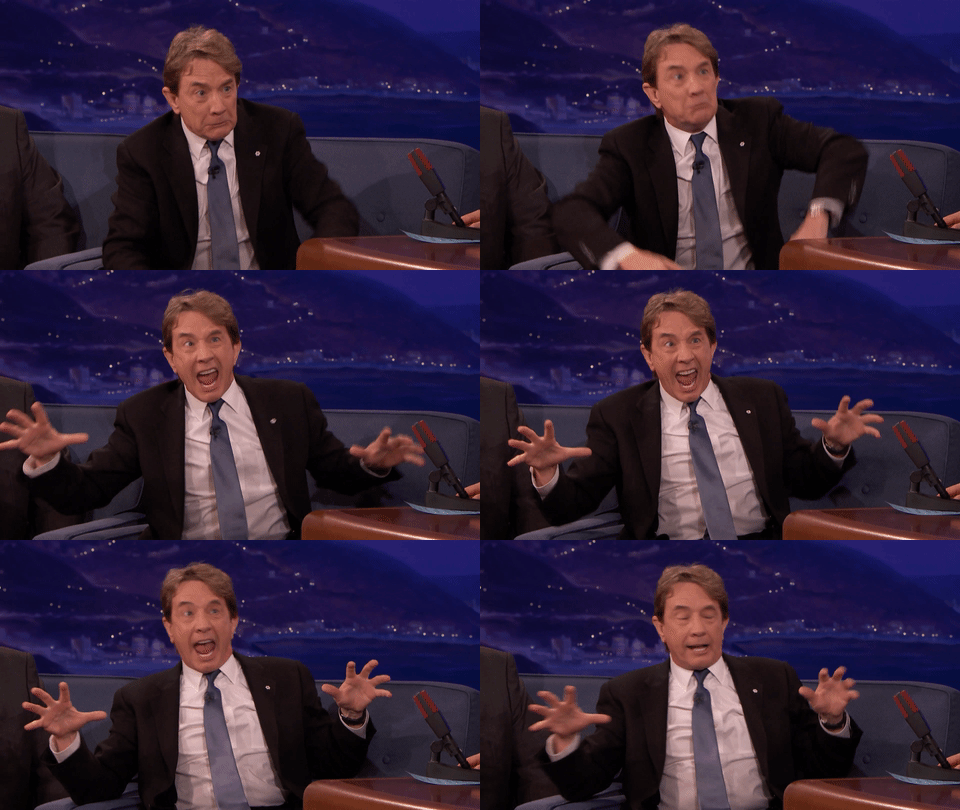
Comic Martin Short tells a story about sitting behind Lucy and Gary Morton on a flight and it was a bit of nightmare, with Morton acting co-dependently with his wife, even threatening Short at one point.

Elizabeth Taylor on the TONIGHT show said that she didn't enjoy being screamed at as Lucy directed her sitcom when Taylor and Burton were on it, asserting that Lucy "wasn't the way she appears on screen" and snarkily added "but she's an icon!"

And there's the story about Joan Crawford's cameo in 1968 when, from the sidelines and watching Lucy throwing a tantrum in rehearsal, Crawford quietly muttered: "My God, and thy say I'm a bitch...!"

So even the queen of the movies was cowed in the presence of the queen of television.


The Two Lucilles:
1601747489206.png
 

Crimson

Telly Talk Enthusiast
LV
2
 
Awards
9
there's the story about Joan Crawford's cameo in 1968

Perhaps the most infamous of the guest appearances on Lucy's show, and wildly diverging accounts of both star's behaviors. Lucy's hairdresser said Joan was blind drunk, worse than Tallulah Bankhead had been. A mutual friend of Joan and Lucille's who was on the set said Joan wasn't drunk, only nervous and that Lucy was instantly hostile towards her. Given the quirks of the two ladies, both scenarios seem equally believable. Whatever the reason, Joan is pretty bad on the show; skittish and for some weird reason sounds like Bette Davis.

Elizabeth Taylor on the TONIGHT show said that she didn't enjoy being screamed at as Lucy directed her sitcom when Taylor and Burton were on it, asserting that Lucy "wasn't the way she appears on screen" and snarkily added "but she's an icon!"

Lucy's counter-complaint about the Burtons is that they were giving lazy, mumbly performances and not keeping up with the rigors of the production. I suspect they thought the week was going to a romp, like being on a Dean Martin special -- get drunk and read off queue cards.

Comic Martin Short tells a story about sitting behind Lucy and Gary Morton on a flight and it was a bit of nightmare, with Morton acting co-dependently with his wife, even threatening Short at one point.

I don't know what the other side of that tale is, but Martin Short seems like someone who would be fidgeting and annoying; if he sat behind me on an airplane, I feel like I'd want to punch him too.

source.gif
 

Crimson

Telly Talk Enthusiast
LV
2
 
Awards
9
I lot of the stories have come out posthumously. If she had been asked, I suspect she would have countered that she was a rare woman running a studio/production company while starring in her own show, and had to be a tough, no-nonsense boss. Carol Burnett recounts Lucy boasting, "and that's when the put the 's' on the end of my name ..."

But Lucy herself didn't seem particularly aware that people took her actions to be mean. She was reportedly hurt and embarrassed by Richard Burton's published diaries, where he professed to despise her. (Although he couldn't have despised her that much; he showed up for a TV testimonial in her honor several years later.) From her perspective, she had just pushed him to give a better performance.
 

Snarky Oracle!

Telly Talk Supreme
LV
8
 
Awards
21
Again, Lucy was infamous in the service industry. I had a friend who was a flight attendant around the time she died, and he was already telling me about her pain-in-the-ass reputation.

Whatever the reason, Joan is pretty bad on the show; skittish and for some weird reason sounds like Bette Davis.
Aries/Scorpio Rising.

Lucy's counter-complaint about the Burtons is that they were giving lazy, mumbly performances and not keeping up with the rigors of the production. I suspect they thought the week was going to a romp, like being on a Dean Martin special -- get drunk and read off queue cards.
Of course, Burton -- like Brando -- always mumbled.

I'm not sure how bad any of them were -- they all just felt like the standard TV cameo appearances of the time: forced an unnecessary, set to excessive studio audience response.
 

Jimmy Todd

Telly Talk Mega Star
LV
5
 
Awards
11
I love the Lucy Ricardo character and
ILL is one of my all time favorite shows. However, for some reason I like to hear stories about her being an uber witch.
 

Crimson

Telly Talk Enthusiast
LV
2
 
Awards
9
That Lucy's behavior fell somewhere between tactless to antagonistically uncongenial is indisputable. Any biography written after the 70s (prior, she was still written as being practically a saint ; coasting along from the martyr-like aura she picked up after the divorce from Desi) delves at least somewhat into the harsher aspects of her personality. People are complicated; they're not soap opera characters. Bad behaviors come from somewhere and there are often mildly to wildly diverging accounts of most of these incidents that make it like triangulating a position on a map. Saying, "She was mean to Andy Griffith" is easy; the nuances of accounts and possible motivations are more interesting to me.

There's a famous anecdote that has been trotted out in a few Lucy biographies about how she berated Jack Benny on the set of HERE'S LUCY. Benny's longtime agent, on the set, disputed that version saying that it was two old friends making caustic remarks to each other. Likewise there are multiple versions of how and why Madeline Kahn got fired from MAME, usually some variation of Lucy as the aging, jealous star. Madeline's own account was more blasé -- Lucy wanted the performance like Jane Connell's on Broadway, so she got Jane Connell. On the other hand, Lucy's mom, DeeDee, interrupted an interview between Lucy and a prospective TV director to warn him that Lucy was an absolute bitch to work for.
 

bmasters9

Telly Talk Mega Star
LV
5
 
Awards
11
I love the Lucy Ricardo character and
ILL is one of my all time favorite shows.

You're not alone in that-- my nephew enjoys that too!
 

ClassyCo

Telly Talk Warrior
LV
5
 
Awards
11
There was one video I saw once where Lucy's bossing people around on the HERE'S LUCY set. She wasn't necessarily being mean, in my opinion at least, but she was laying down the law about what she wanted concerning the lighting and camera angles. She was tough as nails from what I gather, and I'm sure that often come across as harsh. I'm not defending Lucy really, but once people have reputations for being mean, it sometimes doesn't matter what they do because it's going to be viewed as hateful anyway.
 
Top