Puzzles and Paradoxes

Hawkman

Telly Talk Dream Maker
THE PARADOXICAL QUESTION

1 Markosian's Paradox ( paper author- Yunji Ellen Shi of the LSE)

In the paper The Paradox of the Question, Ned Markosian told the following story: during an international conference of leading philosophers, an angel miraculously appeared. The angel claimed to be the messenger from God and granted philosophers with an opportunity to ask one question and he would then answer it truthfully. Philosophers immediately started discussing what they should ask – they wanted to ask the best question to ask. Finally they agreed on the proposal from one young logician:

(Q1)1: What is the ordered pair whose first member is the question that would be the best one for us to ask you, and whose second member is the answer to that question?
(Markosian, 1997)
This indeed seems to be a very good question, for, by asking (Q1), we can ask the best question indirectly and receive its answer, without violating the angel’s rule to ask only one question. So, when the angel appeared again, philosophers presented (Q1) to the angel. The angel replied:

(A1) It is the ordered pair whose first member is the question you just asked me, and whose second member is this answer I am giving you.
Ibid., 96.
Then the angel disappeared, leaving philosophers in frustration. The philosophers asked a seemingly very good question but received an answer which is totally useless. Markosian asked: What went wrong? This is the original paradox of the question. I shall call it Markosian’s paradox, following Wasserman and Whitcomb’s terms of use (Wasserman & Whitcomb, 2011).


2. However, Markosian’s Paradox was shown to be ill-formulated by Theodore Sider (Sider, 1997). Sider showed that the angel is a cheater – on the one hand, (A1) is not a correct answer to (Q1). Because if it is, then (Q1) is indeed the best question to ask. And, as (A1) does not provide any useful information, (Q1) is a question whose answer is useless. A question with a useless answer can hardly be regarded as a good question. Then we arrive at a contradiction. Hence (A1) cannot be a correct answer to (Q1) – the angel did not answer the philosophers truthfully. On the other hand, (Q1) is not the best question to ask. For if it is, the answer to (Q1), whatever it may be, must take the form, "That Question, This Answer."

Answer( A) = ((Q1), A)
which is a useless answer. Hence (Q1) cannot be the best question. Thus, the philosophers in the conference have taken up the wrong belief that (Q1) is the best question to ask due to lack of the above reasoning. And they rely on the imposter angel to give them an answer. As a result, they end up with Markosian’s Paradox. Therefore, Markosian’s Paradox is not truly a paradox – the scenario is not properly-designed, for in fact the angel does not tell the truth at all and the philosophers have not actually come up with the best question to ask. In other words, the Markosian’s Paradox is ill-formulated, and we were led to the paradoxical situation because of our lack of crucial reasoning which can reveal the ill design of the situation.

If the answer given by the angel is wrong, what would the true answer to (Q1) be like? Let’s denote the best question, which is shown to be different from (Q1), by Q. Let’s also denote the answer to Q by Y. A truth-telling angel’s reply to (Q1) will be in the form

(A2): A = (Q, Y)
For example, Q may denote the question that what is the solution to the problem of world hunger and Y in turn denotes the solution to world hunger. However, Sider argues that (A2) generates further paradox. Since the answer (A2) to (Q1) contains both the information that Q is the best question to ask and the information in Y, which is more than the information that Y contains, which is what you get by asking Q , asking (Q1) is better than asking Q. Further, as Q is the best question by stipulation, (Q1) cannot be a better question than Q, so (Q1) must be as good as Q. This means that there does not exist the unique best question to ask. Instead, there are some best questions to ask, which Q and (Q1) are two of. Hence, we should replace (Q1) which asks for the best question to ask and its answer by

(Q2): What is the ordered pair whose first member is one of the best questions to ask, and whose second member is the answer to that question?
Let’s consider whether (Q2) is one of the best questions to ask. Suppose it is, then one of the possible answers to (Q2), denote this answer by Z, takes the form Z=((Q2), Z), which is a useless answer, therefore (Q2) cannot be a good question, let alone one of the best questions. We arrive at a contradiction. Suppose (Q2) is not one of the best questions to ask, then the answer to (Q2) will take the form of (Q*, Y) where Q* is different from (Q2). By the same reasoning as above in red, (Q2) must be as good as Q*, then (Q2) is indeed one of the best questions, which leads us again to a contradiction. (Q2) must either be or not be one of the best questions to ask, but both cases end with a contradiction. Sider claimed that now we are confronted with the genuine paradox of the question. I shall call this paradox Sider’s paradox
 

Hawkman

Telly Talk Dream Maker
3. Two Attempts to Solve Sider’s Paradox
In this section I will evaluate two attempts to solve Sider’s paradoxes. The first solution questions the existence of best questions to ask and the second solution suggests that every question can be answered in a useless way.

3.1 There are no best questions to ask?
A closer look at Sider’s paradox should reveal us an important assumption Sider presupposes in his paradox: that there are some best questions to ask. One could raise an objection to this assumption that there may not exist the best questions – it may be the case that for any question, there is a better question to ask – and hence solve the paradox. Sider has considered this objection and responds that we can come up with another scenario where the angel requires philosophers to ask only one question which can be stated in English within 15 seconds. In this scenario there are only finitely many possible questions eligible, the objection does not hold anymore but the paradox still endures (Sider, 1997).

A more radical further objection can be raised against this assumption that Sider presupposes is that questions are not comparable with respect to goodness. Let’s denote the relation that x is a better question than y by xRy. It is worth noting that for the assumption to hold it is sufficient for the relation R to be a partial order on the set of questions which can be stated in English within 15 seconds. That means, we do not require the best questions to be better than any questions else, we just require that no questions are better than any one of best questions. Using these notations, this radical further objection argues that for any two questions, they are incomparable with respect to the relation R. Namely, we are not able to claim one is better than the other. This radical objection is motivated by the fact that people cannot always arrive at an all-agreed answer to a question on whether question A is better than question B, which is originated by that there lacks a definition for the notion of on question being better than another. So, it is conceivable that there may not exist such a relation of one question being better than another.

Nevertheless, the problem of lacking a precise definition of the notion is not as fatal as the objectors think. The relation of one question being better than another is a vague predicate, as predicates ‘observable’ and ‘moral’, which we may not be able to give a clear definition but are totally entitled to use, as long as there are clear cases and counter-cases (van Fraassen 1980, 16). For example, it would be ridiculous to say that we should doubt whether any two actions are morally comparable for there is no definition for being moral. And we are fully entitled to use the notion of being moral in any reasoning because we know some clear cases and counter-cases of being moral. The same applies to our notion of one question being better than another – we should not hasten to reject the notion based on its lack of definition, for there are cases which we clearly know that one question is better than another.

Consider the following two questions:

(Q3): What is the solution to the problem of world hunger?
(Q4): What is the ordered pair whose first member is the solution to the problem of world hunger and second member is the solution to the climate change?
(Q4) is a better question than (Q3) as its answer provides with one more piece of information. Some people may be still unsatisfied with the above example and further argue that the reason why we prefer (Q4) to (Q3) assumes that there are answers to (Q3) and (Q4) which may not be the case. To avoid this unsatisfaction, we can replace the question of world hunger and the climate change by some other questions for which clearly there exits at least one answer, for example, the first question of 2019 real analysis exam at LSE.


3.2 Every question can be answered in an unhelpful way?
Wasserman and Whitcomb propose another attempt to solve Sider’s paradox from a different angle (Wasserman Whitcomb, 2011). They claim that every question can be truthfully answered in unhelpful ways. For example, suppose we ask the angel:

(Q5): Who is the author of Huckleberry Finn?
The angel can respond truthfully with the answer:

(A3): My favorite author.
If the angel’s favorite author is Mark Twain. Or

If he introduces "A” as proper name for Mark Twain. Or

(A5): The author of Huckleberry Finn.
(A3) - (A5) do not provide us with useful information we want – they are useless answers. Nevertheless, Wasserman and Whitcomb argue that they are all true answers. Following their lines of thought, Sider’s first horn of his paradox that (Q5) cannot be one of the best questions to ask due to its risk to have useless answer does not hold, as every question runs the risk to have useless answer (Wasserman Whitcomb, 2011).

In my opinion, Wasserman and Whitcomb’s claim that every question can be truthfully answered in unhelpful ways is not cogent. For one thing, (A3) and (A4) are not truthful answers unless they are accompanied with the assumptions that the angel’s favorite author is Mark Twain and that ‘A1’ is a proper name for Mark Twain. And when we extend (A3) and (A4) to include their assumptions, they are no longer useless answers. Thus, (A3) and (A4) are truthful answers to (Q3) only when they are not useless.

For another, (A5) can hardly be regarded as an answer to (Q5). (A5) is essentially a tautology stating that the author of Huckleberry Finn is the author of Huckleberry Finn. There are other tautological answers such as that

(A6): The answer of the question you asked is the answer of the question you asked.
Nevertheless, when a question is asked, it can hardly be the case that the inquirer will accept such a tautology as an answer. I believe most people will respond to such answers saying: “you didn’t answer my question!” Tautological answers do not provide any information to the inquirers. Wasserman and Whitcomb go on to insist that not every question is asked to gain information, for example, teachers ask students question to test their understanding while they already know the answers. However, I believe that answers like (A5) and (A6) are more “dangerous" than not providing new information to the inquirer and thus they cannot be accepted as legitimate answers in general.
If (A5) is a legitimate answer to (Q5), then there is no reason to resist the claim that (A6) is a legitimate answer to all questions, which implies any question can be answered by any one person truthfully. This is a counterintuitive, if not ridiculous, claim. It is impossible for one person to be able to answer all questions truthfully – after all, one cannot know everything. One may further object that knowing the answer is not necessarily required for truthfully answering a question, for one could accidentally answer a question truthfully by guessing. But accidentally answering a question truthfully is different from our situation here. As in our case, the statement that one can answer all questions truthfully is a tautological truth given our definition of answers which embraces (A5) and (A6). While it is possible that one can in principle answer all the questions truthfully, in an accidental way, the probability of its happening is so low that it is negligible. Even if we leave the above argument aside, the implication that one is able to answer all questions truthfully is by itself ridiculous and far more paradoxical than Sider’s paradox! Therefore Wasserman and Whitcomb’s solution is not successful.
4 Conclusion
In conclusion, the original paradox of question, i.e. Markosian’s Paradox is ill-formulated, and the real paradoxical situation embedded is Sider’s Paradox. Moreover, two suggested solutions to Sider’s Paradox, one rejects that there exist some best questions to ask and the other claims that every question can be answered in a truthful but unhelpful way, are not successful.


Here's a breakdown of the paradox:
  1. 1. The Setup:
    Imagine an angel appears to a group of philosophers and offers to answer one question truthfully.

  2. 2. The Question:
    The philosophers devise the following question: "What is the ordered pair (x, y) where x is the best question to ask the angel and y is the answer to that question?"

  3. 3. The Paradox:
    If the angel answers truthfully, it must reveal the ordered pair where the first element is the question they just asked (and the answer is the angel's response). But if the question is "best", then the answer must be the best possible answer, which would be something other than what the angel is saying. The answer is true but unhelpful, or unhelpful yet still true. This leads to a contradiction, or at least a highly unsatisfactory outcome.
Why it's a paradox:
The paradox lies in the attempt to define the "best" question within a situation where the answer to that question reveals its own imperfection. It highlights the inherent limitations of language and logic when dealing with self-referential statements or questions.

Key Points:
  • The paradox is not easily solved by simply saying there is no "best" question, as the question itself can be reformulated to avoid that specific objection.

  • The core issue is the tension between the desire for a truthful and helpful answer and the self-referential nature of the question, which can undermine the very conditions of a straightforward answer.

  • The paradox emphasizes the difficulty of defining "best" or "optimal" within a self-referential framework.
 
Last edited:

Hawkman

Telly Talk Dream Maker
The Grue Problem

grue emerald

Nelson Goodman invented this problem, which he called “the new riddle of induction.”
Colours may be defined and even perceived differently by different cultures. Many cultures do not distinguish between blue and green the way English speakers do. The Himba people of northern Namibia have one word, burou, for vivid blues or greens. The word zoozu includes black and some dark greens and blues, while dumbu includes beige, yellow and some light greens. Thus, an English speaker may say that all emeralds are green, while a Himba-speaking person might say that all emeralds are burou.
Grue and Bleen
Now consider a speaker of Gruebleen, a strange language with a special definition for certain colours. The word grue applies to things that are green before midnight on Dec. 31, 2049, and blue thereafter. The word bleen applies to things that are blue before that same moment, and green thereafter. Thus, a Gruebleen speaker, speaking before the year 2050, would say that all emeralds are grue.
Now ask all three people to make a prediction of what colour an emerald will be in the year 2050. The English speaker will say that it will still be green, the Himba speaker will say that it will still be burou, and the Gruebleen speaker will say that it will still be grue. But “grue in the year 2050” means blue!

Grue and bleen seem like unnecessarily complicated concepts to us, but the Gruebleen speaker views our terms the same way. To explain what “green” means, we would have to say that it refers to something that is grue until midnight on Dec. 31, 2049, but then changes to bleen.

The Zero Hour
What makes the terms grue and bleen artificial is the time element they include. A child could be taught that grass is grue and the sky is bleen, but they would not have a full understanding of those terms until the predicted change was explained.

The paradox illustrates the larger problem of induction. Even saying, “all emeralds are green” is problematic, because we have not observed all emeralds. True, the ones we have seen are all green, and that is why we feel safe enough using inductive reasoning to conclude that they are all green. But by doing so, we are in a sense predicting the future, suggesting that emeralds of another colour will never be found.

The Gruebleen language sheds light on this problem. A Gruebleen speaker would say that every emerald ever found is grue, so it is a fairly safe conclusion that all emeralds are grue. She understands that English speakers have a strange prediction, that in 2050 all grue things will change colour to bleen, but she is doubtful.

The only way to find out is to wait for New Year’s Eve, 2049 . If at midnight we see green things suddenly change to blue, we’ll realize that the Gruebleen speakers were right. Our Gruebleen-speaking friend will hold up a blue emerald and say, “See? It was grue all along.” If the change does not occur, we will be the ones saying it was green all along. However, no matter what happens, the Himba speaker will be correct in saying that the emerald stayed burou the whole time.
 

Hawkman

Telly Talk Dream Maker

Hempel’s Ravens Paradox​

The philosopher Carl G. Hempel, in his 1965 essay “Studies in the Logic of Confirmation,” brought to light a central paradox in the scientific method as it is commonly understood.

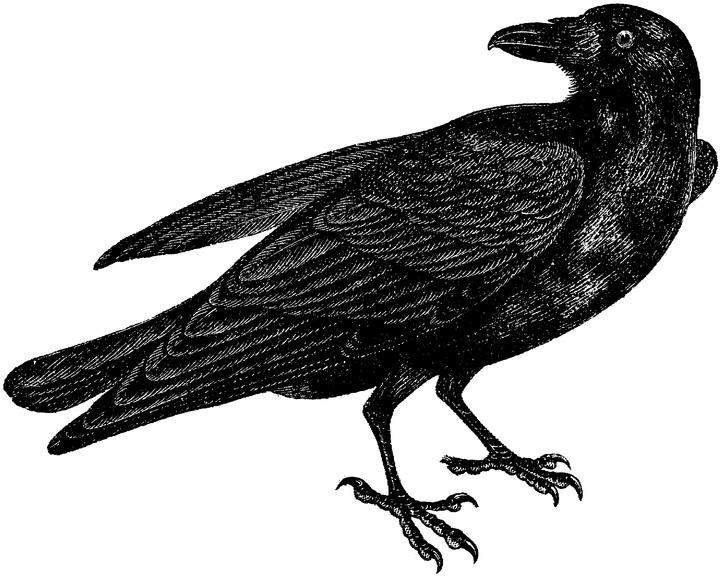
The problem is with inductive reasoning, and Hempel’s example was as follows: Suppose you see a raven, and you note that it is black. “Hmm,” you say, “that raven was black.” Sometime later you notice a couple more ravens, and they also are black. “What a coincidence,” you remark, “those ravens are black too.” Time goes by and you see many more ravens. And it happens that all the ravens you see are black. “This is beyond coincidence,” you might reasonably think, and with the instincts of a good and observant scientist you form a hypothesis: All ravens are black.

raven1.jpg

Black Raven
This is a deliberately simplistic example, but it lays bare what the first step in the scientific method, commonly understood, really amounts to: one makes observations, and forms an inductive hypothesis. The next step, of course, is experimentation to confirm or refute the hypothesis—and it is here that the trouble occurs. In a case like this, experimentation amounts to observing as many ravens as possible, and confirming that they are all black. Now it is impossible, even in principle, to observe every raven, for many no longer exist, many do not yet exist, and it is conceivable that there are creatures one would also wish to call ravens that exist in inaccessible places, such as other planets. There are always limits to an experimental apparatus, even if the apparatus is just a matter of observing as many ravens as possible to check their color. Nonetheless, we feel justified in saying that each new observation of a black raven tends to confirm the hypothesis, and in time, if no green or blue or otherwise non-black ravens are observed, our hypothesis will eventually come to have the status of a natural law.

But is this logical? Note that, logically put, our hypothesis “all ravens are black” has the form of a conditional, that is, a statement of the form “if A then B.” In short, we are saying that if a given object is a raven, then that object is black. According to the laws of logic, a conditional is equivalent to its contrapositive. That is, a statement of the form “if A then B” is equivalent to the statement “if not B then not A.” For example, the statement “if I live in Denver then I live in Colorado” is logically equivalent to the statement “if I do not live in Colorado then I do not live in Denver.” This rule of logic is incontrovertible.

blue_shirt.png

Non-Black Non-Raven
Our hypothesis “all ravens are black” therefore has the equivalent form “all non-black things are non-ravens,” or more precisely, “if an object isn't black then it is not a raven.” Consequently, if every sighting of a black raven confirms our hypothesis, then every sighting of a non-black non-raven equally confirms our hypothesis.

I look at my shirt. It's blue. And it is not a raven. Confirmation! My hypothesis that all ravens are black is strengthened! My coffee cup is red. More confirmation. The grass is green, the sky is blue, my computer is gray, my dog is white—all confirming the hypothesis “all ravens are black.”

Silly, isn't it? (Isn't it?) But by the laws of logic, if I accept inductive hypotheses and confirmation by experiment, then every observation except one that refutes my hypothesis—confirms it. Even if it is totally irrelevant.

Addendum​

Very well, you might say, but maybe every sighting of a non-black non-raven really does confirm, even if only to an infinitessimal degree, the hypothesis that all ravens are black. After all, if we could, somehow, check every non-black object in the universe, and if none of them were ravens, our statement that all ravens are black would be proved.

Just so. Maybe my blue shirt does reinforce, even if only to some tiny degree, the hypothesis that all ravens are black. But if so, then it must also reinforce—to the same degree—a completely contradictory statement, namely, the hypothesis that all ravens are white. After all, my shirt is a non-white non-raven….

Resolving Hempel’s Raven Paradox​

Fred Leavitt reveals how the whiteness of swans proves the blackness of ravens.​

Many scientific theories and laws are of the form “All A is B.” Two examples are “Water at sea level boils at 100 degrees centigrade” and “Schizophrenia is associated with an excess of dopamine in the limbic system.” But philosopher and logician Carl Hempel pointed out a seeming paradox (Hempel, 1945). As virtually all logicians agree, the propositions “All ravens are black” and “All nonblack things are nonravens” are equivalent. To test the former, a scientist would look for ravens and check their colour. A black raven would provide supporting evidence. To test the latter, the scientist would look for nonblack things and check to see if they are nonravens. A white handkerchief would provide supporting evidence.

But if a white handkerchief supports the proposition that all nonblack things are nonravens; and if “All nonblack things are nonravens” is equivalent to “All ravens are black;” a white handkerchief would appear to support the proposition that all ravens are black. The paradox has two aspects: first, that a white handkerchief should be as informative as a black raven; second, that a white handkerchief should have any bearing at all on the proposition “All ravens are black” (or green or red). The paradox seems to have important implications for testing scientific theories.

What follows is my resolution.

There are two propositions (P1 and P2) and two pieces of evidence (E1 and E2).

P1: All ravens are black.
P2: All nonblack things are nonravens.
E1: This raven is black.
E2: This white thing is not a raven.

P1 and P2 are logically equivalent, i.e., any evidence that supports P1 supports P2 to the same extent. But E1 and E2 are not equivalent. E1 provides much stronger support for both propositions. To see why this is so, consider an aviary in which there are exactly two ravens among 100 birds.

P3: All ravens in the aviary are black.
P4: All nonblack birds in the aviary are nonravens.
E3: This raven is black.
E4: This white bird is not a raven.

E3 represents 50% of the evidence needed to prove P3. Less obviously but equally true, it represents 50% of the evidence needed to prove P4. (If the only other raven is found to be black, P4 must be true.)

By checking all 98 nonblack birds and verifying that they are not ravens, an investigator could prove P3. The proof would apply just as convincingly to P4. But a single nonblack nonraven would be less useful than a single black raven, because the former would represent 1/98th of the necessary evidence and the latter 50%.

E1 and E3 are more significant than E2 and E4 because they account for a greater proportion of the total number of cases under consideration. Nevertheless, E2 to a trivial extent and E4 to a much greater extent, account for something – a nonblack nonraven eliminates one potential falsifier of the proposition “All ravens are black.”

© Prof. F. Leavitt 1997
 
Last edited:

Hawkman

Telly Talk Dream Maker
THE SLEEPING BEAUTY PROBLEM


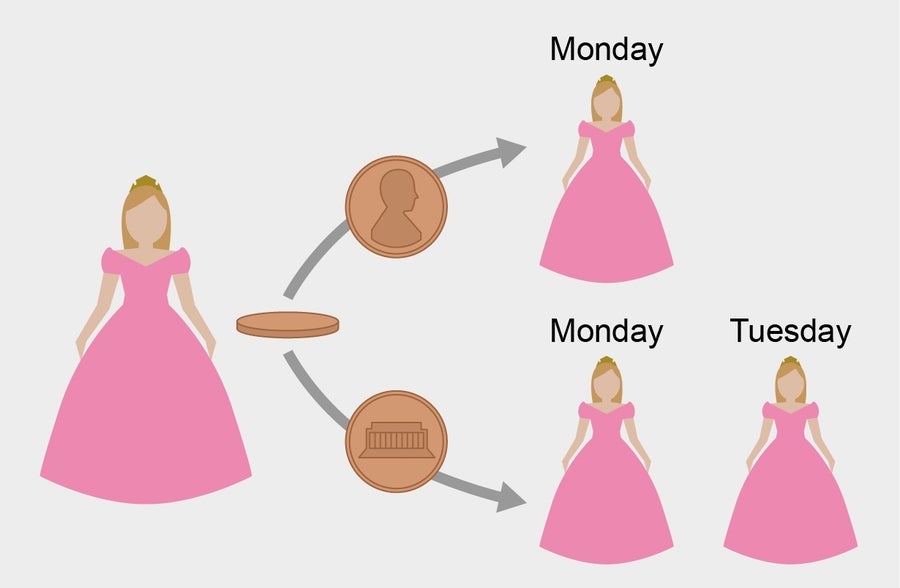
The problem vexing the minds of experts is as follows: Sleeping Beauty agrees to participate in an experiment. On Sunday she is given a sleeping pill and falls asleep. One of the experimenters then tosses a coin. If “heads” comes up, the scientists awaken Sleeping Beauty on Monday. Afterward, they administer another sleeping pill. If “tails” comes up, they wake Sleeping Beauty up on Monday, put her back to sleep and wake her up again on Tuesday. Then they give her another sleeping pill. In both cases, they wake her up again on Wednesday, and the experiment ends.
The important thing here is that because of the sleeping drug, Sleeping Beauty has no memory of whether she was woken up before. So when she wakes up, she cannot distinguish whether it is Monday or Tuesday. The experimenters do not tell Sleeping Beauty either the outcome of the coin toss nor the day.

They ask her one question after each time she awakens, however: What is the probability that the coin shows heads?


sleepingBeauty_graphic_1%5B18%5D.jpg


Depending on the outcome of a coin toss, scientists will wake up Sleeping Beauty either once (heads) or twice (tails). (Illustration Credit: Spektrum der Wissenschaft/Manon Bischoff, styled by Scientific American)
Put yourself in the position of Sleeping Beauty: You wake up, you don’t know what day it is, and you don’t know if you have been woken up before. You only know the theoretical course of the experiment.

My first intuition was that Sleeping Beauty should guess 1/2.The probability of the coin landing on heads or tails—regardless of the rest of the experiment—is always 50 percent. U.S. philosopher David Lewis held the same view when he learned of the problem. After all, one could even flip the coin before sending Sleeping Beauty to sleep. By the experiment’s design, she does not have any extra clues to the situation, so logically she should state the probability as 1/2.
But there are also conclusive arguments in favor of a probability of 1/3. If you think through Sleeping Beauty’s experience, then three scenarios can occur:

She wakes up Monday, and heads was thrown.
She wakes up Monday, and tails was thrown.
She wakes up Tuesday, and tails was thrown.

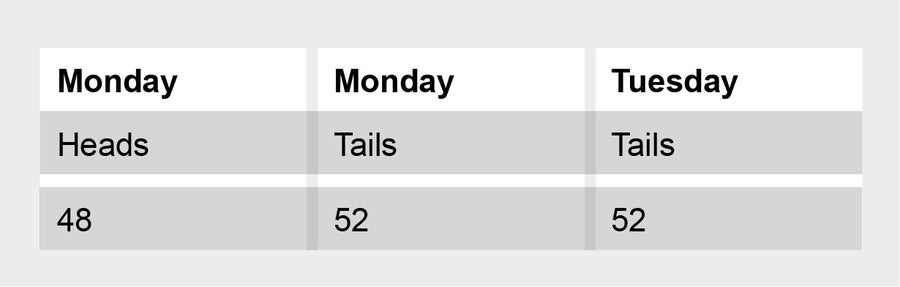
What are the probabilities for each event? You can investigate this both mathematically and empirically. Suppose you flip a coin 100 times and get tails 52 times and heads 48 times. Put another way, the Monday/heads scenario occurs 48 times, and Monday/tails and Tuesday/tails occur 52 times each.

Because Tuesday/tails always follows Monday/tails, the probabilities for all three events are equal—and must therefore be 1/3. When Sleeping Beauty is awakened and asked to answer what the probability of the coin toss was for heads, she should therefore answer 1/3, , according to this reasoning.


sleepingBeauty_graphic_2%5B56%5D.jpg


If after 100 flips, you got heads 48 times and tails 52 times, you could apply those numbers to Sleeping Beauty’s Monday and Tuesday scenarios. You’d discover that these three situations are more or less equally likely to occur.( Illustration Credit: Spektrum der Wissenschaft/Manon Bischoff, styled by Scientific American.)
Philosopher of science Adam Elga of Princeton University, who popularized the Sleeping Beauty problem in 2000, came to this conclusion. He formulated his argument in a mathematically sound way. If Sleeping Beauty is told when she wakes up that today is Monday (M), then the probability of Monday/heads (M, H) and Monday/tails (M, Z) is indisputably equal: P(M, H) = P(M, Z) = 1/2, where P stands for probability. On the other hand, if Sleeping Beauty wakes up and learns that tails have been thrown, then that day could equally be either Monday or Tuesday (T), meaning P(M, Z) = P(T, Z) = 1/2.

According to the calculus of conditional probabilities, it follows that in the general case (without Sleeping Beauty receiving any additional information), the three values are equal: P(M, Z) = P(M, H) = P(T, Z). Because all three probabilities must add up to 1, each individual value is 1/3. In other words, because Sleeping Beauty is awakened twice as often in the case of tails as in the case of heads, she should answer with 1/3, from Elga’s point of view.

Taking It to Extremes
How would you answer the question now that you have heard the two main arguments? To get an even better sense of the Sleeping Beauty problem, it can help to think of a more extreme version of the thought experiment.

Suppose that in the case of tails, Sleeping Beauty will be awakened and questioned not just one additional time the next day but a million times (presumably at smaller intervals—because, even for a fairy tale character, this schedule would be brutal). If you wake her up and ask her the probability that the coin landed on heads, the answer 1/2 doesn’t seem logical in this scenario. If the coin toss results in tails, Sleeping Beauty is questioned a million times in a row, and in the case of heads, she is questioned just once.
But extreme cases can also strengthen the 1/2 camp’s position. For example, instead of a coin toss, a sports bet could be used, such as a footrace pitting retired sprinter Usain Bolt against singer Taylor Swift. In this scenario, if Bolt, a world record holder in multiple running categories, defeats the pop star—as most people would anticipate—Sleeping Beauty will only be awakened once on Monday. But if, contrary to all expectations, Swift proves swifter, Sleeping Beauty must wake up every day for a month, 30 times in a row. The probability of Bolt losing to Swift is very low. But if we apply the same logic that motivated the ⅓ response, we need to treat those scenarios with equal weight. Sleeping Beauty would still have to bet on a Swift victory after waking up because in this—admittedly unlikely—situation, she could be awakened 30 times. Lewis found this argument nonsensical. This thought experiment, he thus contended, supports the 1/2 faction.

Are you now completely confused? You are not alone
 
Last edited:

Hawkman

Telly Talk Dream Maker
MUDDY FACES PUZZLE


A father tells a group of children that at least one of them has a muddy face. " Step forward if you have a muddy face" he tells them, and repeats this request until those with muddy faces steps forward. If there are 'x' muddy children then 'x' will step forward at the ' xth' request, ie if 2 then 2 will step forward at 2nd request, or 4 at 4th request.
But if the father doesn't tell them at the outset that at least one has a muddy face, this will not happen, even if there is more than one muddy face, so that everyone can see there is at least one ,and knows what the father doesn't tell them. Why?


First scenario- Father tells them at least one has a muddy face. They can all see the other faces but not their own. We assume the children are all logically minded, honest and assume the others are too.
Suppose just one has a muddy face, that child will know her face is muddy since she will see that no one else is, so she will step forward. The others will see her face is muddy and not knowing about their own face will stand still.
Suppose two have muddy faces, at the first request to step forward no one will know if their face is muddy. Some will see two muddy faces, two of them will see one, but they all know at least one has a muddy face, so they themselves may or not have one. When no one has stepped forward after the first request they all know there is more than one muddy face. The ones that see one muddy face will conclude their faces must be muddy too. The others will see two muddy faces, not knowing about their own will stand still. If there are three muddy faces then no one will have stepped forward after two requests because everyone will see at least two muddy faces. So they all know more than two are muddy, so therefore the three that only see two muddy faces will know their face is muddy and step forward.

Scenario 2 - Suppose now there is more than one muddy face, so they all know there is at least one. The father though doesn't tell them at least one has a muddy face. Then surprisingly no child will ever step forward even though they know exactly the same as the father told them in scenario 1.
The reason is that in scenario 2 there is no common knowledge. For example, if there is two muddy children, Angela and Mary, neither knows their own face is muddy. At the second request Angela cannot reason that Mary didn't step forward at the first because she saw Angela 's face was muddy, so she cannot reason that there are just two muddy faces when she sees only one other which is muddy. There is UNIVERSAL knowledge that there is one muddy face but there isn't COMMON knowledge. For common knowledge everyone must know that everyone knows that everyone knows. It was achieved in the first scenario because the father's statement that there was at least one muddy face was public, they all heard it and knew everyone heard it.
To explain the difference in UNIVERSAL and COMMON knowledge: traffic lights work only because there is common knowledge that people will stop at red. It is not enough for me to know that red means stop, if I am not confident that other people know this and that THEY know others know etc. Universal knowledge is not sufficient, everyone may know how traffic lights work but they need to know others know. In scenario 1 the children do not need infinite common knowledge. If there is exactly 'x' muddy children then the common knowledge required is that everyone knows that everyone knows that there are at least one muddy child, with " everyone knows " iterated 'x' times.
 
Last edited:

Hawkman

Telly Talk Dream Maker
How the Logic Works (Example with k = 2 Muddy Children: Alice and Bob)
    • Round 1:
      • Alice sees that Bob is muddy. She thinks: "If I am clean, then Bob is the only muddy child. Bob sees no other muddy children, so Bob should realize he is muddy and step forward immediately."
      • Bob looks at Alice and thinks the exact same thing.
      • When the parent asks the first time, neither Alice nor Bob steps forward, because each is waiting to see if the other moves.
    • Round 2:
      • Alice sees Bob didn't step forward on Round 1. She reasons: "Bob didn't step forward, which means Bob must see at least one other muddy child. Since I see no other muddy child besides Bob, I must be the second muddy child!"
      • Bob goes through the exact same deduction.
      • On the second request, both Alice and Bob step forward simultaneously.
 

Hawkman

Telly Talk Dream Maker
Barbershop Paradox

The barbershop paradox was proposed by Lewis Carroll in a three-page essay titled "A Logical Paradox", which appeared in the July 1894 issue of Mind. The name comes from the "ornamental" short story that Carroll uses in the article to illustrate the paradox. It existed previously in several alternative forms in his writing and correspondence, not always involving a barbershop. Carroll described it as illustrating "a very real difficulty in the Theory of Hypotheticals". From the viewpoint of modern logic, it is seen not so much as a paradox than as a simple logical error. It is of interest now mainly as an episode in the development of algebraic logical methods when these were not so widely understood (even among logicians), although the problem continues to be discussed in relation to theories of implication and modal logic.

The paradox​


In the story, Uncle Joe and Uncle Jim are walking to the barber shop. They explain that there are three barbers who live and work in the shop—Allen, Brown, and Carr—and some or all of them may be in. We are given two pieces of information from which to draw conclusions. Firstly, the shop is definitely open, so at least one of the barbers must be in. Secondly, Allen is said to be very nervous, so that he always brings Brown with him wherever he goes.
Now, according to Uncle Jim, Carr is a very good barber, and he wants to know whether Carr will be there to shave him. Uncle Joe insists that Carr is certain to be in, and claims that he can prove it logically. Uncle Jim demands this proof.
Uncle Joe gives his argument as follows:
Suppose that Carr is out. We will show that this assumption produces a contradiction. If Carr is out, then we know this: "If Allen is out, then Brown is in", because there has to be someone in "to mind the shop." But, we also know that whenever Allen goes out he takes Brown with him, so as a general rule, "If Allen is out, then Brown is out". The two statements we have arrived at are incompatible, because if Allen is out then Brown cannot be both In (according to one) and Out (according to the other). There is a contradiction. So we must abandon our hypothesis that Carr is Out, and conclude that Carr must be in.
Uncle Jim's response is that this conclusion is not warranted. The correct conclusion to draw from the incompatibility of the two "hypotheticals" is that what is hypothesized in them (that Allen is out) must be false under our assumption that Carr is out. Then our logic simply allows us to arrive at the conclusion "If Carr is out, then Allen must necessarily be in."

In modern logic theory this scenario is not a paradox. The law of implication reconciles what Uncle Joe claims are incompatible hypotheticals. This law states that "if X then Y" is logically identical to "X is false or Y is true" (not X or Y). For example, given the statement "if you press the button then the light comes on", it must be true at any given moment that either you have not pressed the button, or the light is on.

In short, what obtains is not that Carr is out yields a contradiction, only that it necessitates Allen is in, because Allen is out is what actually yields the contradiction.

In this scenario, that means Carr doesn't have to be in, but that if he isn't in, Allen has to be in.

Barbershop Paradox 2

People often confuse Carroll's puzzle with a different, much more famous puzzle about a village barber.
  • The Setup: In a small town, there is a barber who shaves all men, and only those men, who do not shave themselves.
  • The Question: Who shaves the barber?
  • The Paradox:
    • If the barber shaves himself, then he violates his own rule (since he only shaves men who do not shave themselves).
    • If the barber does not shave himself, then he fits the criteria for someone who should be shaved by the barber, meaning he must shave himself.
  • The Resolution: Such a barber cannot logically exist. The premise itself is contradictory.
 
Last edited:

Hawkman

Telly Talk Dream Maker
PLATO & SOCRATES-1


The Lord Plato is guarding a bridge over a river when Socrates appears. Socrates begs to be allowed passage.
Plato bellows " If the next thing you say is true I will allow passage, but if the next thing you say is false I will throw you in the water"
Socrates being clever says;
" You will throw me in the water"
If Plato does indeed throw Socrates in the water, then Socrates spoke truly and shouldn't have been thrown in, but if he doesn't throw him in, Socrates spoke falsely and should have gone in!
Either way Plato is stuffed!!
But hang on, Plato cannot fulfil his promise, it's logically impossible, so he has no obligation to keep his promise, and assuming free will can throw Socrates in the river if he pleases.
It is argued that statements about future intentions cannot have a truth or false value. Socrates saying " You will throw me in the water " is neither true or false.
However Socrates could have said something avoiding future dependant language that would have avoided a dowsing in the river. What?

Click below for answer.

All Socrates has to do is clarify Plato's intentions.
Statement 'S' " If I speak truly you will not throw me in the river, if I speak falsely you will throw me in the river"
If 'S' is true, then Socrates has spoken truly and won't get thrown in, but if ' S' is false then Socrates has spoken falsely and it's false that Plato will throw him in. So Socrates escapes a dunking whatever Plato wants assuming Plato's integrity

PLATO & SOCRATES-2

Plato has taught Socrates to become a top lawyer and has generously waived his fee, for now. Socrates will pay the tuition fee when he wins his first case. Months pass and Socrates has not been engaged in any cases. Plato anxious for his fee, sues Socrates arguing that if the court decides for him Socrates must pay up, and if it decides for Socrates then that's a case won by Socrates so he"ll still have to pay.
Socrates argues that if the court decides against him in favour of Plato then he hasn't yet won a case and needn't pay, and if it decides for him Plato's case is thrown out and he still won't have to pay. Who is right? What should the court do?

Click below for answer;

The court should not find for Plato, simply because at the time of the lawsuit Socrates hasn't won a case. However this changes afterwards as Socrates has now won, and Plato could instigate a second lawsuit that he will surely win.
 
Last edited:

Hawkman

Telly Talk Dream Maker
THE MONTY HALL PROBLEM


The Monty Hall problem is a brain teaser, in the form of a probability puzzle, based nominally on the American television game show Let's Make a Deal and named after its original host, Monty Hall. The problem was originally posed in a letter by Steve Selvin to the American Statistician in 1975. It became famous as a question from reader Craig F. Whitaker's letter quoted in (and solved by) Marilyn vos Savant's "Ask Marilyn" column in Parade magazine in 1990:

In search of a new car, the player chooses a door, say 1. The game host then opens one of the other doors, say 3, to reveal a goat and offers to let the player switch from door 1 to door 2.
Suppose you're on a game show, and you're given the choice of three doors: Behind one door is a car; behind the others, goats. You pick a door, say No. 1, and the host, who knows what's behind the doors, opens another door, say No. 3, which has a goat. He then says to you, "Do you want to pick door No. 2?" Is it to your advantage to switch your choice?
Savant's response was that the contestant should switch to the other door. By the standard assumptions, the switching strategy has a 2/3 probability of winning the car, while the strategy of keeping the initial choice has only a 1/3 probability.

When the player first makes their choice, there is a 2/3 chance that the car is behind one of the doors not chosen. This probability does not change after the host reveals a goat behind one of the unchosen doors. When the host provides information about the two unchosen doors (revealing that one of them does not have the car behind it), the 2/3 chance of the car being behind one of the unchosen doors rests on the unchosen and unrevealed door, as opposed to the 1/3 chance of the car being behind the door the contestant chose initially.
The given probabilities depend on specific assumptions about how the host and contestant choose their doors. An important insight is that, with these standard conditions, there is more information about doors 2 and 3 than was available at the beginning of the game when door 1 was chosen by the player: the host's action adds value to the door not eliminated, but not to the one chosen by the contestant originally. Another insight is that switching doors is a different action from choosing between the two remaining doors at random, as the former action uses the previous information and the latter does not. Other possible behaviors of the host than the one described can reveal different additional information, or none at all, leading to different probabilities. In her response, Savant states:


Suppose there are a million doors, and you pick door #1. Then the host, who knows what's behind the doors and will always avoid the one with the prize, opens them all except door #777,777. You'd switch to that door pretty fast, wouldn't you?
Many readers of Savant's column refused to believe switching is beneficial and rejected her explanation. After the problem appeared in Parade, approximately 10,000 readers, including nearly 1,000 with PhDs, wrote to the magazine, most of them calling Savant wrong. Even when given explanations, simulations, and formal mathematical proofs, many people still did not accept that switching is the best strategy. Paul Erdős, one of the most prolific mathematicians in history, remained unconvinced until he was shown a computer simulation demonstrating Savant's predicted result.

The problem is a paradox of the veridical type, because the solution is so counterintuitive it can seem absurd but is nevertheless demonstrably true.
 
Last edited:

Hawkman

Telly Talk Dream Maker
Steve Selvin wrote a letter to the American Statistician in 1975, describing a problem based on the game show Let's Make a Deal, dubbing it the "Monty Hall problem" in a subsequent letter. The problem is equivalent mathematically to the three prisoners problem described in Martin Gardner's "Mathematical Games" column in Scientific American in 1959 and the Three Shells Problem described in Gardner's book Aha Gotcha.

Standard assumptions​

Ambiguities in the Parade version do not explicitly define the protocol of the host. However, Marilyn vos Savant's solution printed alongside Whitaker's question implies, and both Selvin and Savant explicitly define, the role of the host as follows:
  1. The host must always open a door that was not selected by the contestant.
  2. The host must always open a door to reveal a goat and never the car.
  3. The host must always offer the chance to switch between the door chosen originally and the closed door remaining.
It is also presumed that the car is placed (uniformly) at random behind one of the doors and that, if the player initially chooses the car, then the host's choice of which goat-hiding door to open is also made (uniformly) at random.
Under these standard assumptions, the probability of winning the car after switching is 2/3. Varying the assumptions can change the probability of winning by switching doors as detailed in the section below.
These assumptions specify the mathematical model of host behavior and prize distribution being analyzed. In a decision-theoretic reading, whether switching is rational for the contestant also depends on the contestant knowing, or having reason to assume, that the host follows this protocol.

Simple solutions​

1 and 2 below ,Switch and Win, 3 ,stay and win.
Three initial configurations of the game. In two of them, the player wins by switching away from the choice made before a door was opened.

The solution presented by Savant in Parade shows the three possible arrangements of one car and two goats behind three doors and the result of staying or switching after initially picking door 1 in each case:

Behind door 1Behind door 2Behind door 3Result if staying at door #1Result if switching to the door offered
GoatGoatCarWins goatWins car
GoatCarGoatWins goatWins car
CarGoatGoatWins carWins goat
A player who stays with the initial choice wins in only one out of three of these equally likely possibilities, while a player who switches wins in two out of three.

An intuitive explanation is that, if the contestant initially picks a goat (2 of 3 doors), the contestant will win the car by switching because the other goat can no longer be picked – the host had to reveal its location – whereas if the contestant initially picks the car (1 of 3 doors), the contestant will not win the car by switching. Using the switching strategy, winning or losing thus only depends on whether the contestant has initially chosen a goat (2/3 probability) or the car (1/3 probability). The fact that the host subsequently reveals a goat in one of the unchosen doors changes nothing about the initial probability.

A different selection process, where the player chooses at random after any door has been opened, yields a different probability.
Most people conclude that switching does not matter, because there would be a 50% chance of finding the car behind either of the two unopened doors. This would be true if the host selected a door to open at random, but this is not the case. The host-opened door depends on the player's initial choice, so the assumption of independence does not hold. Before the host opens a door, there is a 1/3 probability that the car is behind each door. If the car is behind door 1, the host can open either door 2 or door 3, so the probability that the car is behind door 1 and the host opens door 3 is 1/3×1/2=1/6.
{\displaystyle \textstyle {\frac {1}{3}}\times {\frac {1}{2}}={\frac {1}{6}}.}
If the car is behind door 2 – with the player having picked door 1 – the host must open door 3, such the probability that the car is behind door 2 and the host opens door 3 is 1/3×1=1/3.
{\displaystyle \textstyle {\frac {1}{3}}\times 1={\frac {1}{3}}.}
These are the only cases where the host opens door 3, so if the player has picked door 1 and the host opens door 3, the car is twice as likely to be behind door 2 as door 1. The key is that if the car is behind door 2 the host must open door 3, but if the car is behind door 1 the host can open either door.
 
Last edited:

Hawkman

Telly Talk Dream Maker
Another way to understand the solution is to consider together the two doors initially unchosen by the player. As Cecil Adams puts it, "Monty is saying in effect: you can keep your one door or you can have the other two doors". The 2/3 chance of finding the car has not been changed by the opening of one of these doors because Monty, knowing the location of the car, is certain to reveal a goat. The player's choice after the host opens a door is no different from if the host offered the player the option to switch from the original chosen door to the set of both remaining doors. The switch in this case clearly gives the player a 2/3 probability of choosing the car.


Car has a 1/3 chance of being behind the player's pick and a 2/3 chance of being behind one of the other two doors.

The host opens a door, the odds for the two sets don't change but the odds become 0 for the open door and 2/3 for the closed door.
As Keith Devlin says, "By opening his door, Monty is saying to the contestant 'There are two doors you did not choose, and the probability that the prize is behind one of them is 2/3. I'll help you by using my knowledge of where the prize is to open one of those two doors to show you that it does not hide the prize. You can now take advantage of this additional information. Your choice of door A has a chance of 1 in 3 of being the winner. I have not changed that. But by eliminating door C, I have shown you that the probability that door B hides the prize is 2 in 3.'"

Savant suggests that the solution will be more intuitive with 1,000,000 doors rather than 3. In this case, there are 999,999 doors with goats behind them and one door with a prize. After the player picks a door, the host opens 999,998 of the remaining doors. On average, in 999,999 times out of 1,000,000, the remaining door will contain the prize. Intuitively, the player should ask how likely it is that, given a million doors, they managed to pick the right one initially. Stibel et al. proposed that working memory demand is taxed during the Monty Hall problem and that this forces people to "collapse" their choices into two equally probable options. They report that when the number of options is increased to more than 7 people tend to switch more often; however, most contestants still incorrectly judge the probability of success to be 50%.
 

Hawkman

Telly Talk Dream Maker
THE GRELLING NELSON PARADOX
is "Heterological" Heterological ?


A predicate expression is heterological if and only if it doesn't apply to itself, and autological only if it does.
For example, " is monosyllabic ", " is a French phrase", and " is three words long" are heterological since they don't apply to themselves. Whereas " is polysyllabic ", " is an English phrase", and " is four words long", are autological. It is either/ or, heterological or autological no middle ground possible. A word must either describe itself or it doesn't, the bivalency rule. Simple words like cat are heterological because the word cat isn't a cat. "Pronounceable" is autological because it describes itself ie it's pronounceable. "Unpronounceable" is heterological because it doesn't describe itself ie it is also perfectly pronounceable.
Now,
Q: is " heterological " heterological?
If " heterological " is heterological it doesn't apply to itself, so " heterological " isn't heterological, so it's autological, so it does apply to itself, so it is heterological, so it doesn't. If it does apply to itself, it doesn't, and if it doesn't it does!
We have a problem!


1a
One solution is to treat predicates about predicates as one level higher than their subjects, so that a statement about a predicate is only accepted as significant if its predicate is of a level one higher than that of its subject. So " short" cannot apply to itself since both subject and predicate in " Short is short" would be the same level.
Heterological is heterological will also be disqualified for the same reason, as will Heterological is autological.
On this view the question of whether Heterological is heterological or autological cannot properly be asked. But it is highly counterintuitive to dismiss as meaningless the statements that "Short" is short ,or "monosyllabic" is not monosyllabic.
This rule about predicate levels seems gerrymandered to avoid the paradox.
1 b
An alternative solution is to recognise a hierarchy of " heterologicals" and "autologicals."
Call " heterological ²" a second level predicate which is true of first level predicates which don't apply to themselves." Heterological ³" is true only of first and second level predicates and is a third level predicate. This hierarchy differs from 1a in allowing predicates to apply to themselves, except same level heterologicals and autologicals, this exception means there will be no " heterological " which applies to all levels so the paradox is avoided.
2.
A better solution is possibly to say Heterological is heterological is neither true or false since it is not a statement with any genuine content. When we consider whether it is true that " monosyllabic " is monosyllabic we look at the number of syllables and see it isn't. But we cannot tell from the expressions " heterological " or " autological" whether or not they apply to themselves. In order to know whether Heterological is heterological we need to know whether it applies to itself, that is, we need to already know the answer to our question before we then ask and then answer it ! But we can say " Short" is autological because it's short or monosyllabic is heterological because it's not monosyllabic.
 
Last edited:

Hawkman

Telly Talk Dream Maker
Suppose one interprets the adjectives "autological" and "heterological" as follows:

  1. An adjective is autological (sometimes homological) if it describes itself. For example, the English word "English" is autological, as are "unhyphenated" and "pentasyllabic".
  2. An adjective is heterological if it does not describe itself. Hence "long" is a heterological word (because it is not a long word), as are "hyphenated" (because it has no hyphen) and "monosyllabic" (because it has more than one syllable).
All adjectives, it would seem, must be either autological or heterological, for each adjective either describes itself, or it does not. Problems arise in a number of instances, however.

The Grelling–Nelson paradox arises when we consider the adjective "heterological". One can ask: Is "heterological" a heterological word? If the answer is "no", then "heterological" is autological. This leads to a contradiction, for in this case "heterological" does not describe itself: it must be a heterological word. But if the answer is "yes", then "heterological" is heterological. This again leads to a contradiction, because if the word "heterological" describes itself, it is autological.

  • Is "heterological" a heterological word?
    • no → "heterological" is autological → "heterological" describes itself → "heterological" is heterological, contradiction
    • yes → "heterological" is heterological → "heterological" does not describe itself → "heterological" is not heterological, contradiction
The paradox can be eliminated, without changing the meaning of "heterological" where it was previously well-defined, by modifying the definition of "heterological" slightly to hold all nonautological words except "heterological". But "nonautological" is subject to the same paradox, for which this evasion is not applicable because the rules of English uniquely determine its meaning from that of "autological". A similar slight modification to the definition of "autological" (such as declaring it false of "nonautological" and its synonyms) might seem to correct that, but the paradox still remains for synonyms of "autological" and "heterological" such as "self-descriptive" and "non–self-descriptive", whose meanings also would need adjusting, and the consequences of those adjustments would then need to be pursued, and so on. Freeing English of the Grelling–Nelson paradox entails considerably more modification to the language than mere refinements of the definitions of "autological" and "heterological", which need not even be in the language for the paradox to arise. The scope of these obstacles for English is comparable to that of Russell's paradox for mathematics founded on sets.

Arbitrary cases
One may also ask whether "autological" is autological. It can be chosen consistently to be either:

  • if we say that "autological" is autological and then ask whether it applies to itself, then yes, it does, and thus is autological;
  • if we say that "autological" is not autological and then ask whether it applies to itself, then no, it does not, and thus is not autological.
This is the opposite of the situation for heterological: while "heterological" logically cannot be autological or heterological, "autological" can be either. (It cannot be both, as the category of autological and heterological cannot overlap.)

In logical terms, the situation for "autological" is:
"autological" is autological if and only if "autological" is autological
A if and only if A, a tautology
while the situation for "heterological" is:
"heterological" is heterological if and only if "heterological" is autological
A if and only if not A, a contradiction.
Ambiguous case
One may also ask whether "loud" is autological or heterological. If said loudly, "loud" is autological; otherwise, it is heterological. This shows that some adjectives cannot be unambiguously classified as autological or heterological. Newhard sought to eliminate this problem by taking Grelling's Paradox to deal specifically with word types as opposed to word tokens.
 

Hawkman

Telly Talk Dream Maker
NEWCOMBE'S PUZZLE

Before you are two boxes, a transparent one containing £10,000, and an opaque one which contains £1,000,000 or nothing. You have a choice between taking the opaque box alone or taking both of them. A Predictor with a highly successful record predicted whether you are going to take both boxes or just one.
If he predicted that you will take just the opaque box he has put a million in it: if he predicted you will take both boxes he has left the opaque box empty..And you know this. Should you take one box or two ?

At first sight it looks as if you are being offered an easy chance of enriching yourself. The temptation is to take one box to get the million. For, if you take one box, won't the Predictor have anticipated your choice and put a million in that box?
The expectation from the alternative two box choice is a mere ten thousand.
But there is a powerful argument against this policy. The Predictor has already made his prediction and determined the contents of the box. Whatever you do now will not change that, you cannot change the past.
If you take both boxes you will get £10,000 more than if you take just the opaque box, and this is so whether it is empty or contains a million. If the opaque box is empty one-boxers get nothing and two- boxers get £10,000. If it has money in it, one-boxers get £1,000,000, two-boxers get £1,010,000. Either way two-boxers get more. The two box choice is said to dominate the one box choice.
The predominant but by no means unanimous view among academics is that you should take both boxes and follow the dominance principle. Suppose you do this, then it is not true that you would have been a millionaire if you had taken only the opaque box. For you would have acquired nothing. But the one- boxer will retort that if you had taken just one box you would be richer, since the Predictor would have predicted your choice and filled the box accordingly.
Suppose I say, " lucky you didn't light a match in that room we were just in because you would have caused an explosion, because the room was full of gas."
You reply, " No it's not lucky, if I had lit a match it wouldn't have been full of gas because I'm a careful person."
I say, "But it is what I say, not what you say, that is relevant to deciding whether it is safe to light a match in a gas filled room, I've only just told you about the gas." If we rule out backwards causation, future effecting the past, then similarly we must regard the contents of the opaque box as already fixed. The only relevant, counterfactual sentence to the one or two box choice is the two- boxers " if I had taken only one box I should be £10,000 worse off."
But what if you knew the Predictor was infallible? You would know there were only two possible outcomes. You would either get the million in the opaque box or £10,000 from choosing both boxes. The possibilities of getting £1,010,000, and of getting nothing drop out because these would only be realized if you falsified the prediction.
If you choose the opaque box, there is no point in regretting that you didn't choose both and get £10,000 more, because in that case the Predictor wouldn't have been infallible contrary to what you know.
But if it is rational here to take just one box why does it cease to be rational if it is just highly probable that the Predictor is right?
It is not to the point to object that we never could know that the Predictor was completely infallible. All we need to get this argument going is the claim that if the Predictor were known to be infallible, two- boxing would not be rational.
Suppose that nevertheless rationality does dictate the two box option. And suppose that the transparent box contains just one euro. Then although I believe it is rational to take both boxes I know there are distinguished one- boxers which suggest I might have got it wrong. I can easily afford to lose a single euro on the off chance that I have got it wrong. That may seem a reasonable thing to do, but if I haven't got it wrong after all, does it make it more rational?
Of course as a two- boxer I could wish I had thought it was more rational to be a one- boxer, in which case the Predictor would probably have put money in the opaque box. But I can't bring that about by changing my mind and taking just one box because the contents of the box are already determined. I could get one- boxers to convince me, so then when I next faced the Predictor he would have anticipated my one box choice and put money in the opaque box. I now would have a reason for one- boxing which I once thought bad, but now think is good, so I now have an irrational belief.
But is it irrational to get myself into that position? No: it can be quite rational to cause yourself to act irrationally. Suppose a burglar is threatening to torture me unless I open my safe, and I take a drug which makes me temporarily irrational. He starts to torture me and while complaining about how much it hurts, I encourage him to go on. He realises his threats can no longer influence me and that his best recourse is to flee. In the circumstances it was perfectly rational to make myself irrational. Though rationality would seem to dictate two- boxing.
 
Last edited:
Top