Random TV Ratings

TaranofPrydain

Telly Talk Fan
LV
0
 
Awards
6
What does the 54.1 rating for Texaco Star Theater in 1951 mean compared to the 32.0 rating for All in the Family in 1973? Does that really mean more viewers, or is it not really comparable because fewer people had televisions in 1951 and there were fewer people living in the United States in 1951 than in 1973?
The latter. There were very few TV sets in homes in 1950.
 

Snarky Oracle!

Telly Talk Supreme
LV
8
 
Awards
21
What does the 54.1 rating for Texaco Star Theater in 1951 mean compared to the 32.0 rating for All in the Family in 1973? Does that really mean more viewers, or is it not really comparable because fewer people had televisions in 1951 and there were fewer people living in the United States in 1951 than in 1973?

And the way these things were tabulated has changed many times over. So the numbers can be tricky.

The latter. There were very few TV sets in homes in 1950.

Yes, in 1950 only 10% of American homes had a television, with millions buying those TV sets to see Milton Burle and Lucille Ball. By 1959, 90% of American homes had a television.
 

Daniel Avery

Admin
LV
9
 
Awards
24
There are usually two numbers cited in ratings.

An example: The Daniel Avery Show 22.5/40

From what I understand, the first number is the "rating," or estimated number of people watching. If one rating point equals 1 million viewers, they estimated 22.5 million people watched The Daniel Avery Show. The number equated with one rating point has gone up and down over the years (typically between 700k and 1.1 million) but I'll call it 1 million just to make the math easy.

The second number, not always cited but also important for analysis is the "share" of the available audience. In this example, out of all the households who could have been or were watching television, the share of TV's tuned to TDAS was 40 (implying the other 60% were pathetic losers watching something else).

Ratings and share numbers kept going down as options for viewing increased, as more channels kept drawing potential viewers away from the traditional networks. In 1963, TDAS would have been #16 for the week, but in 2024 it would not only be #1, it would be several million viewers ahead of the #2 show.
 

Snarky Oracle!

Telly Talk Supreme
LV
8
 
Awards
21
There are usually two numbers cited in ratings.

An example: The Daniel Avery Show 22.5/40

From what I understand, the first number is the "rating," or estimated number of people watching. If one rating point equals 1 million viewers, they estimated 22.5 million people watched The Daniel Avery Show. The number equated with one rating point has gone up and down over the years (typically between 700k and 1.1 million) but I'll call it 1 million just to make the math easy.

The second number, not always cited but also important for analysis is the "share" of the available audience. In this example, out of all the households who could have been or were watching television, the share of TV's tuned to TDAS was 40 (implying the other 60% were pathetic losers watching something else).

Ratings and share numbers kept going down as options for viewing increased, as more channels kept drawing potential viewers away from the traditional networks. In 1963, TDAS would have been #16 for the week, but in 2024 it would not only be #1, it would be several million viewers ahead of the #2 show.

TDAS --- so ahead of its time!
 

Snarky Oracle!

Telly Talk Supreme
LV
8
 
Awards
21
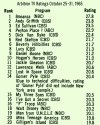
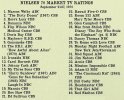
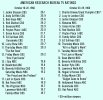
Look how many movies got better ratings than the weekly TV shows.

Back then, it was the only place you could see the movies -- if you hadn't caught them in the theatre.

GOMER PYLE's ratings always mystified me. Even as a child, it was too irritating to sit through (and still is). Of course, at the time, I missed the erotic chemistry between Gomer & His Sergeant.

Gomer-297x300.jpg
 

Daniel Avery

Admin
LV
9
 
Awards
24
Look how many movies got better ratings than the weekly TV shows.
Look how confusing it was for them to report two weeks of ratings in one listing. ;)

It was also the only place you could see older movies considered "classics," since theaters focused almost exclusively on new releases and there was no "media" market like tapes or DVDs. The networks were mostly broadcasting "recent" films (several years after their theater debut) but would occasionally show an older, major classic like when CBS would show Gone With the Wind every year or so (split up over two nights). ABC would air The Ten Commandments on Easter. Can't recall who (CBS?) would air The Wizard of Oz. I saw The Towering Inferno on TV rather than in a theater, and I'd love to see it on a big screen someday.

Obviously the real treasure trove of old movies was in syndication and aired late at night on all the channels in various formats, but they were never measured for ratings.
 

Snarky Oracle!

Telly Talk Supreme
LV
8
 
Awards
21

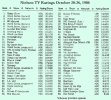
It was always so weird how huge THE COSBY SHOW's rating were -- becoming the Number 1 show for five years --- its seasonal numbers were as high as DALLAS' were at its peak.

I lost interest in COSBY after one season. But its popularity, what the show was and what it wasn't, fit nicely into that mid-'80s zeitgeist.

Today, it's just another one of those '80s entities that's hard to sit through.
 
Top