Random TV Ratings

Snarky Oracle!

Telly Talk Supreme
LV
8
 
Awards
21
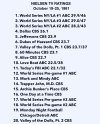
Funnily enough, I always think of SANFORD AND SON as a Norman Lear show.

But, wasn't it??

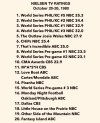
On the flip side, shows like HERE'S LUCY didn't even make the Top 30 here (it's #33 for the week), which I guess is fitting considering this was its final year. More youth-aimed sitcoms, such as THE BRADY BUNCH (at #36) and THE PARTRIDGE FAMILY (at #61), also shocked me.

Lucy retired from sitcom in 1974, perhaps because her brand was tarnishing a bit after 23 years as Queen of Television. A girl gets tired.

PARTRIDGE FAMILY was in its fourth (and final) season, and ABC moved it from Friday to Saturday nights, directly against ALL IN THE FAMILY (the top show of the time, by leaps and bounds).
 

Daniel Avery

Admin
LV
9
 
Awards
24
He and Bud Yorkin (I think that's his name) adapted the concept from a British series. Lear and Yorkin's Tandem Productions produced the show, but after the two got it on the air, I think Lear sort of handed it over to Yorkin to handle day-to-day operations. Lear still co-owned it and had his name on it, though, so it was considered in his stable of shows but Yorkin was the show-runner.
 

Snarky Oracle!

Telly Talk Supreme
LV
8
 
Awards
21
He and Bud Yorkin (I think that's his name) adapted the concept from a British series. Lear and Yorkin's Tandem Productions produced the show, but after the two got it on the air, I think Lear sort of handed it over to Yorkin to handle day-to-day operations. Lear still co-owned it and had his name on it, though, so it was considered in his stable of shows but Yorkin was the show-runner.

STEPTOE & SON
 

Jock Ewing Fan

Telly Talk Star
LV
0
 
Awards
8
Ratings are an interesting topic, because the numbers are objective (at least according to the methodology)

the perception of quality is largely subjective.

The entire industry has changed, and it seems that "niche" programming is much more viable,

because it requires fewer episodes. Many a series that was cancelled because of low ratings

back when the choices were limited to 3 networks might have a better chance today.
 

Daniel Avery

Admin
LV
9
 
Awards
24
The lists of ratings sometimes do not tell the whole story, though, especially the weekly round-ups. A show's rating for that week might be adversely affected by a one-time sporting event or a movie that normally did not air against the show. The show may have been airing in a different time slot than usual, or aired a rerun that week (though I remember that TV Guide used to denote such by putting (R) after the title). Sometimes a show might have a different lead-in than usual, which might add or subtract some viewers.

The "overall ratings" for a week or a season did give a better idea of the trends that the viewers cared about; the "overnights" were what the network execs and the producers obsessed over because every single rating point meant millions in ad revenue and even small changes in viewership could determine whether they kept their jobs.
 

ClassyCo

Telly Talk Warrior
LV
5
 
Awards
11
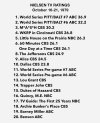
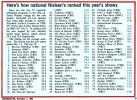
It's interesting to see WKRP at #4 for the week here, especially when I always think of it struggling to find an audience.

But there's something that's always thrown me with these rating charts. It says that 60 MINUTES and ONE DAY AT A TIME are tied as the #6 show of the week. If that's so, why wouldn't THE JEFFERSONS be the #7 most watched show of the week? Do they tally the ratings this way to keep up with the number of shows? Either way, it irks me just a tad.

1000002482.jpg
 
Last edited:

Snarky Oracle!

Telly Talk Supreme
LV
8
 
Awards
21
It says that 69 MINUTES and ONE DAY AT A TIME are tied as the #6 show of the week. If that's so, why wouldn't THE JEFFERSONS be the #7 most watched show of the week? Do they tally the ratings this way to keep up with the number of shows? Either way, it irks me just a tad.

69 MINUTES was soon cancelled. And we know why.
 

Monzo

Telly Talk Enthusiast
LV
1
 
Awards
9
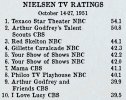
What does the 54.1 rating for Texaco Star Theater in 1951 mean compared to the 32.0 rating for All in the Family in 1973? Does that really mean more viewers, or is it not really comparable because fewer people had televisions in 1951 and there were fewer people living in the United States in 1951 than in 1973?
 

TaranofPrydain

Telly Talk Fan
LV
0
 
Awards
6
What does the 54.1 rating for Texaco Star Theater in 1951 mean compared to the 32.0 rating for All in the Family in 1973? Does that really mean more viewers, or is it not really comparable because fewer people had televisions in 1951 and there were fewer people living in the United States in 1951 than in 1973?
The latter. There were very few TV sets in homes in 1950.
 

Snarky Oracle!

Telly Talk Supreme
LV
8
 
Awards
21
What does the 54.1 rating for Texaco Star Theater in 1951 mean compared to the 32.0 rating for All in the Family in 1973? Does that really mean more viewers, or is it not really comparable because fewer people had televisions in 1951 and there were fewer people living in the United States in 1951 than in 1973?

And the way these things were tabulated has changed many times over. So the numbers can be tricky.

The latter. There were very few TV sets in homes in 1950.

Yes, in 1950 only 10% of American homes had a television, with millions buying those TV sets to see Milton Burle and Lucille Ball. By 1959, 90% of American homes had a television.
 

Daniel Avery

Admin
LV
9
 
Awards
24
There are usually two numbers cited in ratings.

An example: The Daniel Avery Show 22.5/40

From what I understand, the first number is the "rating," or estimated number of people watching. If one rating point equals 1 million viewers, they estimated 22.5 million people watched The Daniel Avery Show. The number equated with one rating point has gone up and down over the years (typically between 700k and 1.1 million) but I'll call it 1 million just to make the math easy.

The second number, not always cited but also important for analysis is the "share" of the available audience. In this example, out of all the households who could have been or were watching television, the share of TV's tuned to TDAS was 40 (implying the other 60% were pathetic losers watching something else).

Ratings and share numbers kept going down as options for viewing increased, as more channels kept drawing potential viewers away from the traditional networks. In 1963, TDAS would have been #16 for the week, but in 2024 it would not only be #1, it would be several million viewers ahead of the #2 show.
 
Top