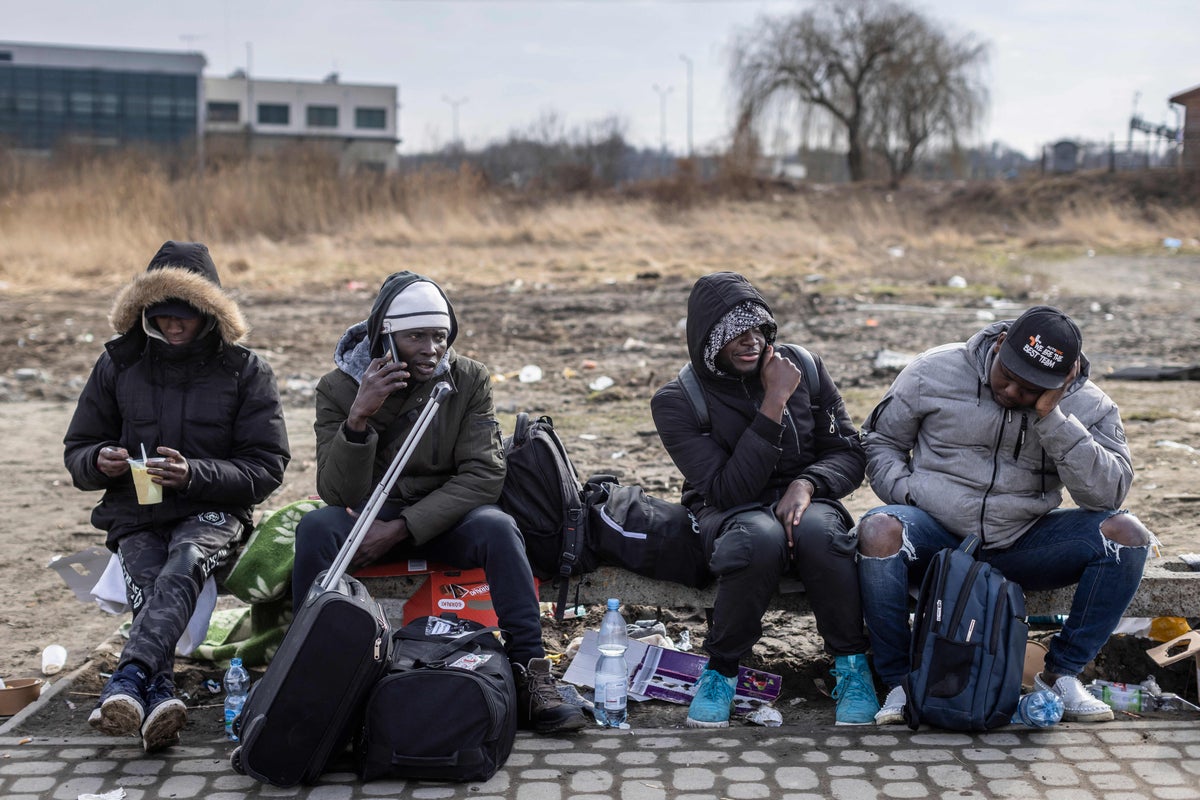
Russia begins the invasion

Angela Channing

Telly Talk Veteran
LV
19
 
Awards
52

Jock Ewing Fan

Telly Talk Star
LV
0
 
Awards
8
Some food for thought.

Whether Putin is successful ultimately depends on the combined efforts of Western democracies responses.
So far, Putin has encountered obstacles, but he doesn't appear to be discouraged by sanctions, etc.

So in a battle between Putin and the West, the winner is... China!

Western democracies and the Eastern ones will be expending funds, resources, energy, personnel, etc in their efforts
against Putin while inflation, pandemic related shortages, self-imposed energy restrictions, and ideological divides
hamper their efforts.
Putin will face sanctions, financial difficulties, the need for massive utilization of troops and resources, negative media reports, etc
but he seemed undeterred so far.

China does not have to expend any funds, resources, energy, , etc.
They can sit and watch both sides battle.

I am not suggesting that the West retreat. Far from it.
The West should consider any and all viable options, and this situation has
evolved because of Putin's success in Crimea, Chechnya, Syria etc,
and the lack of effective response from the West.


All the while, President Xi continues to build China into an
economic colossus.
Entertainment projects are incorporating the Chinese market more and more
into the projects, China continues to build their infrastructure with effectiveness and efficiency,
dissent is not tolerated, even by non-Chinese entities who are editing
content to please China, etc

This is not an anti-China observation. The Chinese people can not openly express dissent,
and they must adhere to their government's policies.
The West can simply not continue to appease China's behavior
and expect positive results.


If China's influence continues at this rate,
it is only a matter of time before Chinese policies encroach on Western freedoms.
The West may be dealing with partisan divides now
which certainly has its issues (In a democracy, the right to dissent can and should
lead to discussions about the rights of its citizens) but if China
becomes the leading superpower, what will become of the rights
that we all enjoy? We can not rely on China's goodwill to uphold
the freedoms granted by the The Constitution, The Magna Carta, etc. and
the traditions of the Bible, the Torah, etc (I know that these documents had some flaws, but
the ideals are still the best that the world has produced)

Again the West has appeased Putin and China for too long,
and the consequences are disastrous, and could be even more catastrophic

Again we should pray for the Ukranian people and voice our support
 

Biggie

Telly Talk Hero
LV
4
 
Awards
14
Even during a war some people still want to be racist against black people.

And yet Putin is painted as the bad guy. Ukraine is clearly a cesspit where racists thrive. The same ghastly racists that want other people in foreign countries to protect them. What a circus.
 

Frank Underwood

Telly Talk Champion
LV
3
 
Awards
9

US and NATO provoked Ukraine War say most experts on Russia -- but the mainstream media won't tell you that​


US/NATO Provoked Ukraine War Say Most Experts On Russia - YouTube
The same mainstream media that constantly refers to Putin's "unprovoked" aggression has acted as cheerleaders for every war the US has ever started.

Russian discourse amounts to "Trump/Putin bad" among liberals, and they refuse to acknowledge the role US meddling (including that of Biden in 2014) played in this mess.

Weeks before the Russian invasion of Ukraine began, an article appeared in Salon that gave a more objective account:

In the rapidly worsening Ukraine fiasco, the U.S. is reaping exactly what it sowed​

U.S. media spins a one-sided narrative of Russian aggression — but decades of U.S. meddling is what got us here​


So what are Americans to believe about the rising tensions over Ukraine? The United States and Russia both claim their escalations are defensive, responding to threats and escalations by the other side, but the resulting spiral of escalation can only make war more likely. Ukrainian President Volodymyr Zelensky is warning that "panic" by U.S. and Western leaders is already causing economic destabilization in Ukraine.

American allies do not all support the current U.S. policy. Germany is wisely refusing to funnel more weapons into Ukraine, in keeping with its longstanding policy of not sending weapons into conflict zones. Ralf Stegner, a senior Member of Parliament for Germany's ruling Social Democrats, told the BBC on Jan. 25 that the Minsk-Normandy process agreed to by France, Germany, Russia and Ukraine in 2015 is still the right framework for ending the civil war.

"The Minsk Agreement hasn't been applied by both sides," Stegner explained, "and it just doesn't make any sense to think that forcing up the military possibilities would make it better. Rather, I think it's the hour of diplomacy."

By contrast, most American politicians and corporate media have fallen in line with a one-sided narrative that paints Russia as the aggressor in Ukraine, and support sending more and more weapons to Ukrainian government forces. After decades of U.S. military disasters based on such one-sided narratives, Americans should know better by now. But what are our leaders and the corporate media not telling us this time?

The most critical events that have been airbrushed out of the West's political narrative are the violation of agreements made by Western leaders at the end of the Cold War not to expand NATO into Eastern Europe, and the U.S.-backed coup in Ukraine in February 2014. Western mainstream media accounts date the crisis in Ukraine back to Russia's 2014 reintegration of Crimea, and the decision by ethnic Russians in eastern Ukraine to secede from Ukraine as the Luhansk and Donetsk People's Republics.

But these were not unprovoked actions. They were responses to the U.S.-backed coup, in which an armed mob led by the neo-Nazi Right Sector militia stormed the Ukrainian parliament, forcing elected President Viktor Yanukovych and members of his party to flee for their lives. After the events of Jan. 6, 2021, in Washington, that scenario should now be easier for Americans to understand.

The remaining members of parliament voted to form a new government, subverting the political transition and plans for a new election that Yanukovych had publicly agreed to a day earlier, after meetings with the foreign ministers of France, Germany and Poland.

The U.S. role in managing the coup was exposed by a leaked 2014 audio recording of a conversation between Assistant Secretary of State Victoria Nuland and U.S. ambassador Geoffrey Pyatt as they planned to sideline the European Union ("f**k the EU," as Nuland put it) and shoehorn in U.S. protégé Arseniy Yatsenyuk ("Yats") as Ukraine's prime minister.

At the end of the call, Pyatt told Nuland, "We want to try to get somebody with an international personality to come out here and help to midwife this thing."

Nuland replied (verbatim): "So on that piece, Geoff, when I wrote the note, [Biden's national security advisor Jake] Sullivan's come back to me VFR [very quickly?], saying you need [Vice President] Biden and I said probably tomorrow for an attaboy and to get the deets to stick. So Biden's willing."

It has never been explained why two senior State Department officials who were discussing a regime change in Ukraine looked to then-Vice President Biden to "midwife this thing," instead of their actual boss, Secretary of State John Kerry.

Now that the crisis over Ukraine has blown up with a vengeance during Biden's first year as president, the unanswered questions about his role in the 2014 coup have become more urgent and troubling. And why did Biden appoint Nuland to the No. 4 position at the State Department, despite (or because of?) her critical role in triggering the disintegration of Ukraine and an eight-year- civil war that has killed at least 14,000 people?

Both of Nuland's hand-picked puppets in Ukraine, Prime Minister Yatsenyuk and President Petro Poroshenko, were soon mired in corruption scandals. Yatsenyuk was forced to resign after two years and Poroshenko was outed in a tax evasion scandal revealed in the Panama Papers. Ukraine remains the poorest country in Europe, and one of the most corrupt.

The Ukrainian military had little enthusiasm for a civil war against its own people in eastern Ukraine, so the post-coup government formed new "National Guard" units to assault the separatist republics. The infamous Azov Battalion drew its first recruits from the Right Sector militia and openly displays neo-Nazi symbols, yet has kept on receiving U.S. arms and training, even after Congress explicitly cut off its U.S. funding in the 2018 defense appropriation bill.

In 2015, the Minsk and Normandy negotiations led to a ceasefire and the withdrawal of heavy weapons from a buffer zone around the separatist-held areas. Ukraine agreed to grant greater autonomy to Donetsk, Luhansk and other ethnically Russian areas of Ukraine, but it has failed to follow through on that.

A federal system, with some powers devolved to individual provinces or regions, could help to resolve the all-or-nothing power struggle between Ukrainian nationalists and Ukraine's traditional ties to Russia that has dogged its politics since independence in 1991.

But the U.S. and NATO's interest in Ukraine is not really about resolving its regional differences, but about something else altogether. The U.S. coup was calculated to put Russia in an impossible position. If Russia did nothing, post-coup Ukraine would sooner or later join NATO, as NATO members had already agreed in principle in 2008. NATO forces would advance right up to Russia's border and Russia's important naval base at Sevastopol in the Crimea would fall under NATO control.

If Russia had responded to the coup by invading Ukraine, on the other hand, there would have been no turning back from a disastrous new Cold War with the West. To Washington's frustration, Russia found a middle path out of this dilemma, by accepting the result of Crimea's referendum to rejoin Russia, but only giving covert support to the separatists in the East.

In 2021, with Nuland once again installed in a corner office at the State Department, the Biden administration quickly cooked up a plan to put Russia in a new pickle. The U.S. had already given Ukraine $2 billion in military aid since 2014, and Biden has added another $650 million to that, along with deployments of U.S. and NATO military trainers.

Ukraine has still not implemented the constitutional changes called for in the Minsk agreements, and the unconditional military support the U.S. and NATO have provided has encouraged Ukraine's leaders to effectively abandon the Minsk-Normandy process and simply reassert sovereignty over all of Ukraine's territory, including Crimea.

In practice, Ukraine could only recover those territories by a major escalation of the civil war, and that was exactly what Ukraine and its NATO backers appeared to be preparing for in March 2021. But that prompted Russia to begin moving troops and conducting military exercises, within its own territory (including the disputed territory of Crimea), but close enough to Ukraine to deter a new offensive by Ukrainian government forces.

In October, Ukraine launched new attacks in Donbass. Russia, which still had about 100,000 troops stationed near the Ukrainian border, responded with new troop movements and military exercises. U.S. officials launched an information warfare campaign to frame Russia's troop movements as an unprovoked threat to invade Ukraine, concealing their own role in fueling the threatened Ukrainian escalation to which Russia is responding. U.S. propaganda has even preemptively dismissed any actual new Ukrainian assault in the east as a Russian false-flag operation.

Underlying all these tensions is NATO's expansion through Eastern Europe to the borders of Russia, in violation of commitments Western officials made at the end of the Cold War. The U.S. and NATO's refusal to acknowledge that they have violated those commitments or to negotiate a diplomatic resolution with the Russians is a central factor in the breakdown of U.S.-Russian relations.

While U.S. officials and corporate media are scaring the pants off Americans and Europeans with tales of an impending Russian invasion of Ukraine, Russian officials warn that U.S.-Russian relations are close to the breaking point. If the U.S. and NATO are not prepared to negotiate new disarmament treaties, remove U.S. missiles from countries bordering Russia and dial back NATO expansion, Russian officials say they will have no option but to respond with "appropriate military-technical reciprocal measures."

This expression may not refer to an invasion of Ukraine, as most Western commentators have assumed, but to a broader strategy that could include actions that hit much closer to home for Western leaders.

For example, Russia could place short-range nuclear missiles in Kaliningrad (a sliver of Russian territory between Lithuania and Poland), within range of European capitals. It could establish military bases in Iran, Cuba, Venezuela and other friendly countries. It could deploy submarines armed with hypersonic nuclear missiles to the western Atlantic, where they could destroy Washington in a matter of minutes.

It has long been a common refrain among American activists to point to the 800 or so U.S. military bases all over the world and ask, "How would Americans like it if Russia or China built military bases in Mexico or Cuba?" Well, we may be about to find out.

Hypersonic nuclear missiles off the East Coast would put the U.S. in a similar position to that in which NATO has placed the Russians. China could adopt a similar strategy in the Pacific to respond to U.S. military bases and deployments around its coast.

So the revived Cold War that U.S. officials and corporate media hacks have been mindlessly cheering on could very quickly turn into one in which the U.S. finds itself just as encircled and endangered as its enemies.

Will the prospect of such a 21st-century Cuban Missile Crisis be enough to bring America's irresponsible leaders to their senses and back to the negotiating table, to start unwinding the suicidal mess they have blundered into? We certainly hope so.

Source: https://www.salon.com/2022/02/02/in...asco-the-us-is-reaping-exactly-what-it-sowed/
 

Emelee

Telly Talk Warrior
LV
6
 
Awards
16
If that was to happen, who would fill the void? That person could be a greater cause for concern.

Or someone who realizes the currect dictator is a threat to everyone and needs to be eliminated?

I doubt Russians who believe in Putin's lies will be happy when the Russian economy hits rock bottom and few countries imports or exports with them etc. Eventually, they have to turn against Putin. A second Russian revolution is possible.
 

Frank Underwood

Telly Talk Champion
LV
3
 
Awards
9
There's a lot to loathe about Putin, but getting rid of him won't solve the US's aggression towards Russia or their meddling in Ukraine which caused this "unprovoked" attack.

Many liberals have also shown their xenophobia towards Russia. They're not just taking their hostility out on Putin, they're taking it out on people of Russian descent by supporting boycotts, censorship, and sanctions. The hypocrisy is truly something to behold after hearing them chastise Trump over his treatment of immigrants and refugees.

I'm anti-war and a supporter of diplomacy, but calling this an unprovoked attack and ignoring the US's role in it does a disservice to the victims.

Yes, Putin's a tyrant — that doesn't mean his Ukraine demands are unreasonable​

Vladimir Putin is an amoral opportunist — but he's right that America and its allies double-crossed him on NATO​


It is certainly true that, as American critics assert, Russian President Vladimir Putin's attitude towards civil liberties and political opponents is exactly what you'd expect of a former KGB agent. Yet it is also true that his current demands are not unreasonable. In fact, much of what Putin wants, the United States originally promised and then went back on.

Putin's central demand is that NATO remove troops from countries that joined the group of U.S.-allied nations after 1997. In 1990, under George H.W. Bush, Secretary of State James Baker repeatedly promised Soviet premier Mikhail Gorbachev and other Soviet leaders that if the USSR let the Warsaw Pact nations leave, NATO would not "move one inch eastward." As is detailed in declassified U.S., Soviet, German, British and French documents released in 2017, Bush and the leaders of West Germany, the U.K. and France gave similar assurances.

When the German magazine Der Spiegel examined these documents and interviewed those involved, its reporters concluded that "there was no doubt that the West did everything it could to give the Soviets the impression that NATO membership was out of the question for countries like Poland, Hungary or Czechoslovakia."

Today, those three former Warsaw Pact countries and two others, in addition to the three former Baltic Soviet republics and several formerly neutral countries, are members of NATO.

Putin and other Russian leaders have complained bitterly about this Western duplicity, complaints echoed by Gorbachev. Numerous others have made similar criticisms, including former CIA Director Robert Gates, Cold War diplomat and historian George Kennan, and Jack Matlock, the last U.S. ambassador to the Soviet Union.

In 1995, 18 retired U.S. foreign service and State and Defense Department officers signed a letter denouncing these NATO recruitments, saying they would convince Russians that the U.S. was seeking to "isolate, encircle, and subordinate them." It is this NATO penetration into Russia's sphere that is the root cause of the current conflict.

Some justify NATO's expansion by claiming Russia was a threat to its neighbors. Yet in the decade after the fall of the USSR, the Russian economy and military were in catastrophic condition. UN economists Vladimir Popov and Jomo Kwame Sundaram explain:

In Russia, output fell by 45% during 1989-1998 ... the huge collapse in output, living standards and life expectancy in the former Soviet Union during the 1990s without war, epidemic or natural disaster was unprecedented.

According to defense analyst Pavel Felgenhauer, in this era Russia had "a shambles of an army" which "astonished outside observers with its weakness, low morale, [and] poor discipline."

The U.S. and NATO quickly took advantage — in 1992 military "contact teams" were sent to the Baltic nations, and the recruitment of Poland, the Czech Republic, Hungary and Slovakia began.

Today's advocates of a strong stand against Russia primarily cite Russia's 2014 annexation of Crimea as justification. But this also is more complicated than it seems.

In 1954, Soviet premier Nikita Khrushchev administratively transferred the Crimea to the Ukraine, an essentially meaningless move at the time, since no one anticipated the demise and breakup of the Soviet Union several decades later. When Ukraine declared independence in 1991, it took Crimea along, even though there are four times as many ethnic Russians as Ukrainians in Crimea, which had been part of Russia since its annexation under Catherine the Great in 1783. Not long after Ukrainian independence, a pro-Russian popular movement arose in Crimea, which was repressed by the Ukrainian government.

In 2014, the U.S.-backed Maidan revolution overthrew the pro-Russian Ukrainian government of President Viktor Yanukovych, replacing it with a strongly pro-Western government. Russia, which at the time was ringed with U.S. military bases in Afghanistan, some of the former Soviet Central Asian republics and the Middle East — as well as NATO bases stretching from the Black Sea to the Baltic republics — feared this might lead to a NATO naval base at Sevastopol on the Black Sea, previously a major Russian and Soviet naval and commercial port. Faced with what it perceived as a potential strategic disaster, Russia seized Crimea and reincorporated it into Russia.

Putin is an amoral opportunist, and he certainly did not send troops into Crimea out of concern for the Crimean people. But it's nonetheless true that a majority of Crimeans supported a union with Russia, and voted accordingly in an election held over Crimea's new status.

The current conflict in eastern Ukraine is broadly similar. After the Maidan revolution, the Ukrainian government repressed and sought to de-Russify populations in Donetsk and Luhansk, together known as the Donbas, a region that lies along Ukraine's southeastern border with Russia. Russian is the main language of 75% of residents in Donetsk and nearly 70% in Luhansk. A Russian separatist movement has emerged in the region, clearly supported by Putin's government.

Putin's other demands include banning the deployment of intermediate-range missiles in Europe, a guarantee that Ukraine will not join NATO, a U.S.-Russian agreement that both nations will refrain from deploying troops in areas where they could be seen as a threat to the other's security and a similar agreement not to send aircraft or warships into areas where they could strike each other's territory. None of these are inherently unreasonable; certainly the U.S. would never tolerate Russian military activity as close to U.S. territory as U.S. military activity is to Russia right now.

It's doubtful that Vladimir Putin wants war with the U.S., and unclear whether he is willing to risk a large-scale ground invasion of Ukraine. What he wants is for Russia's grievances to be taken seriously.

Source: https://www.salon.com/2022/01/30/ye...nt-mean-his-ukraine-demands-are-unreasonable/
 
Last edited:

Jock Ewing Fan

Telly Talk Star
LV
0
 
Awards
8
There's a lot to loathe about Putin, but getting rid of him won't solve the US's aggression towards Russia or their meddling in Ukraine which caused this "unprovoked" attack.

Many liberals have also shown their xenophobia towards Russia. They're not just taking their hostility out on Putin, they're taking it out on people of Russian descent by supporting boycotts, censorship, and sanctions. The hypocrisy is truly something to behold after hearing them chastise Trump over his treatment of immigrants and refugees.

I'm anti-war and a supporter of diplomacy, but calling this an unprovoked attack and ignoring the US's role in it does a disservice to the victims.

Yes, Putin's a tyrant — that doesn't mean his Ukraine demands are unreasonable​

Vladimir Putin is an amoral opportunist — but he's right that America and its allies double-crossed him on NATO​


It is certainly true that, as American critics assert, Russian President Vladimir Putin's attitude towards civil liberties and political opponents is exactly what you'd expect of a former KGB agent. Yet it is also true that his current demands are not unreasonable. In fact, much of what Putin wants, the United States originally promised and then went back on.

Putin's central demand is that NATO remove troops from countries that joined the group of U.S.-allied nations after 1997. In 1990, under George H.W. Bush, Secretary of State James Baker repeatedly promised Soviet premier Mikhail Gorbachev and other Soviet leaders that if the USSR let the Warsaw Pact nations leave, NATO would not "move one inch eastward." As is detailed in declassified U.S., Soviet, German, British and French documents released in 2017, Bush and the leaders of West Germany, the U.K. and France gave similar assurances.

When the German magazine Der Spiegel examined these documents and interviewed those involved, its reporters concluded that "there was no doubt that the West did everything it could to give the Soviets the impression that NATO membership was out of the question for countries like Poland, Hungary or Czechoslovakia."

Today, those three former Warsaw Pact countries and two others, in addition to the three former Baltic Soviet republics and several formerly neutral countries, are members of NATO.

Putin and other Russian leaders have complained bitterly about this Western duplicity, complaints echoed by Gorbachev. Numerous others have made similar criticisms, including former CIA Director Robert Gates, Cold War diplomat and historian George Kennan, and Jack Matlock, the last U.S. ambassador to the Soviet Union.

In 1995, 18 retired U.S. foreign service and State and Defense Department officers signed a letter denouncing these NATO recruitments, saying they would convince Russians that the U.S. was seeking to "isolate, encircle, and subordinate them." It is this NATO penetration into Russia's sphere that is the root cause of the current conflict.

Some justify NATO's expansion by claiming Russia was a threat to its neighbors. Yet in the decade after the fall of the USSR, the Russian economy and military were in catastrophic condition. UN economists Vladimir Popov and Jomo Kwame Sundaram explain:


According to defense analyst Pavel Felgenhauer, in this era Russia had "a shambles of an army" which "astonished outside observers with its weakness, low morale, [and] poor discipline."

The U.S. and NATO quickly took advantage — in 1992 military "contact teams" were sent to the Baltic nations, and the recruitment of Poland, the Czech Republic, Hungary and Slovakia began.

Today's advocates of a strong stand against Russia primarily cite Russia's 2014 annexation of Crimea as justification. But this also is more complicated than it seems.

In 1954, Soviet premier Nikita Khrushchev administratively transferred the Crimea to the Ukraine, an essentially meaningless move at the time, since no one anticipated the demise and breakup of the Soviet Union several decades later. When Ukraine declared independence in 1991, it took Crimea along, even though there are four times as many ethnic Russians as Ukrainians in Crimea, which had been part of Russia since its annexation under Catherine the Great in 1783. Not long after Ukrainian independence, a pro-Russian popular movement arose in Crimea, which was repressed by the Ukrainian government.

In 2014, the U.S.-backed Maidan revolution overthrew the pro-Russian Ukrainian government of President Viktor Yanukovych, replacing it with a strongly pro-Western government. Russia, which at the time was ringed with U.S. military bases in Afghanistan, some of the former Soviet Central Asian republics and the Middle East — as well as NATO bases stretching from the Black Sea to the Baltic republics — feared this might lead to a NATO naval base at Sevastopol on the Black Sea, previously a major Russian and Soviet naval and commercial port. Faced with what it perceived as a potential strategic disaster, Russia seized Crimea and reincorporated it into Russia.

Putin is an amoral opportunist, and he certainly did not send troops into Crimea out of concern for the Crimean people. But it's nonetheless true that a majority of Crimeans supported a union with Russia, and voted accordingly in an election held over Crimea's new status.

The current conflict in eastern Ukraine is broadly similar. After the Maidan revolution, the Ukrainian government repressed and sought to de-Russify populations in Donetsk and Luhansk, together known as the Donbas, a region that lies along Ukraine's southeastern border with Russia. Russian is the main language of 75% of residents in Donetsk and nearly 70% in Luhansk. A Russian separatist movement has emerged in the region, clearly supported by Putin's government.

Putin's other demands include banning the deployment of intermediate-range missiles in Europe, a guarantee that Ukraine will not join NATO, a U.S.-Russian agreement that both nations will refrain from deploying troops in areas where they could be seen as a threat to the other's security and a similar agreement not to send aircraft or warships into areas where they could strike each other's territory. None of these are inherently unreasonable; certainly the U.S. would never tolerate Russian military activity as close to U.S. territory as U.S. military activity is to Russia right now.

It's doubtful that Vladimir Putin wants war with the U.S., and unclear whether he is willing to risk a large-scale ground invasion of Ukraine. What he wants is for Russia's grievances to be taken seriously.

Source: https://www.salon.com/2022/01/30/ye...nt-mean-his-ukraine-demands-are-unreasonable/
You are quite well-informed and you articulate this well.

At this point, I am still trying to analyze the complexities

What I can say is that the Russian invasion of the Ukraine has world-wide repercussions,
and it would be a huge mistake to trust and/or underestimate Putin
 

Jock Ewing Fan

Telly Talk Star
LV
0
 
Awards
8
Or someone who realizes the currect dictator is a threat to everyone and needs to be eliminated?

I doubt Russians who believe in Putin's lies will be happy when the Russian economy hits rock bottom and few countries imports or exports with them etc. Eventually, they have to turn against Putin. A second Russian revolution is possible.
You could be right but I don't know how this will progress( regress?)
Based on 20th and 21st century post WW1 Soviet/Russian history, I don't know how the populace will react.
Their mindset may be quite different from that of Western democracies
 

Emelee

Telly Talk Warrior
LV
6
 
Awards
16
You could be right but I don't know how this will progress( regress?)
Based on 20th and 21st century post WW1 Soviet/Russian history, I don't know how the populace will react.
Their mindset may be quite different from that of Western democracies

I'm thinking that money talks, especially if you're suddenly extremely poor and starving. And your family is starving. How long before you turn against your leader and realize his leadership is harmful to ordinary Russians? They aren't robots. I think most Russians are smart enough to know that Putin is crazy. So far, many have either been scared to rebel or haven't had enough motivation for it. But even those who've been pro-Putin should have their limits.

I can't let myself be too pessimistic.
 

Biggie

Telly Talk Hero
LV
4
 
Awards
14
Or someone who realizes the currect dictator is a threat to everyone and needs to be eliminated?

I doubt Russians who believe in Putin's lies will be happy when the Russian economy hits rock bottom and few countries imports or exports with them etc. Eventually, they have to turn against Putin. A second Russian revolution is possible.
All potentially viable. But if we draw from recent history, when the western regimes couldn't get Saddam Hussein and Muammar Gaddafi to acquest to their every whim which the all knowing bastions of freedom and democracy expected because they know best... right.

So removing them from power was gonna afford Libya and Iraq a new tomorrow. Halcyon days with "freedom" and all the other rubbish that the west punt as the way to live right et cetera.

That didn't happen, at all. The vacuum left by removing these to dictators autocrats despots or what ever label is pinned on them was filled by unhinged crazies that looted the arsenals that Gaddafi and Hussein had amassed and are happy to use.

Remove or kill Putin, who's to say the same won't happen. The only difference being that the crazies loot fissile material.
 

Emelee

Telly Talk Warrior
LV
6
 
Awards
16
All potentially viable. But if we draw from recent history, when the western regimes couldn't get Saddam Hussein and Muammar Gaddafi to acquest to their every whim which the all knowing bastions of freedom and democracy expected because they know best... right.

So removing them from power was gonna afford Libya and Iraq a new tomorrow. Halcyon days with "freedom" and all the other rubbish that the west punt as the way to live right et cetera.

That didn't happen, at all. The vacuum left by removing these to dictators autocrats despots or what ever label is pinned on them was filled by unhinged crazies that looted the arsenals that Gaddafi and Hussein had amassed and are happy to use.

Remove or kill Putin, who's to say the same won't happen. The only difference being that the crazies loot fissile material.

Iraq & Libya aren't Russia. They don't even have the same religion. Russia doesn't have to become like the west and be a real democracy to function well and peacefully.
 

Biggie

Telly Talk Hero
LV
4
 
Awards
14
Iraq & Libya aren't Russia. They don't even have the same religion. Russia doesn't have to become like the west and be a real democracy to function well and peacefully.
Iraq, Libya, Russia and every other country are all susceptible to every conceivable flavor of human orchestrated calamity and chaos. The Russian Orthodox Church is a branch of Christianity. Christianity Judaism and Islam are all Abrahamic religions so....

Russia, keeping in mind that I live in the UK, seem on the whole peaceful. On a par with other first world countries I'd suggest. Usually. Democracy is trumpeted by the "West" as an elixir for all the "problem" states. Democracy has been a tool wielded by dictators and madmen in the west.
 

Frank Underwood

Telly Talk Champion
LV
3
 
Awards
9
It's strange to me that US imperialism is either ignored or approved, while Russian imperialism is condemned. I expect that view from the US, but it exists outside of it too.

The US's unbridled imperialism far outweighs that of Russia, and it even contributed to Russia's invasion of Ukraine. And yet nobody's talking about driving the American people into poverty and starving them in order to get them to revolt against their government. Then again, the US drove its own citizens into poverty without outside help.
 
Last edited:
Top